Tomorrow is the anniversary of Martin Luther King, Jr.'s assassination at the Lorraine Motel. When we arrived today to tour the National Civil Rights Museum at the Lorraine Motel, a stage was being set up in front of the motel, maybe for a commemoration tomorrow? We did not see an indication of what the event might be.
 |
| National Civil Rights Museum at the Lorraine Motel. |
 |
The wreath indicates where Martin Luther King, Jr.
was standing when he was assassinated |
After we traded our vouchers for tickets, we headed into the first set of exhibits before the movie. There was so much to read and absorb that we waited for two more cycles of people going into the movie before we finally went in.
The first exhibit hall details how and from where people were abducted to be sold into slavery. Most African Americans originally came from West Africa where they were scholars, mathematicians, craftspeople, architects, hunters, and farmers. Their empires grew rich trading gold, ivory, iron, and slaves.
In the 1400s, European explorers began arriving in West Africa. They joined the trade in slaves. European demand for slaves exploded after they colonized the Americas. Africans, with their agricultural skills and tolerance for tropical climates, became a prized commodity. Europeans were known to start conflicts between African rulers knowing that the victors in those battles would sell the prisoners of war into slavery.
This new type of war was solely for the purpose of selling people into bondage on the other side of the world where they would labor, without any rights, until they died. By 1820, nearly four Africans crossed the Atlantic for every European. It was a global system that brought Africans to the New World by the millions.
 |
| This is a staggering statistic! |
Next, we were ushered into a large movie theater to watch the story of Martin Luther King, Jr.'s assassination. He went to Memphis after two sanitation truck workers were crushed to death in their truck. He wanted to help striking sanitation workers and, in the process, call attention to the greater injustice of the denial of human rights.
The museum is divided into chronological sections:
A culture of resistance: slavery in America 1619-1861.
The year they walked: Montgomery Bus Boycott 1955-1956.
 |
| Exhibits on the Montgomery Bus Boycott. |
Standing up by sitting down: student sit-ins 1960.
 |
| Non-violent protests: iunch counter sit-ins. |
Say it loud: black pride 1966-1975.
Martin Luther King, Jr. advocated non-violence. Black protestors were given classes in non-violent protest. Freedom Riders were activist volunteers who rode interstate buses throughout the South in 1961 to challenge the non-enforcement of the U.S. Supreme Court decisions ruling that segregated buses were unconstitutional. About 75% of the Freedom Riders were between 18-30 years old, 50% were black and a fourth of them were women.
It was May 14, 1961 (Mother's Day) that one of the famous bus attacks occurred. It was hard to read about the Freedom Riders and the ambush of the bus they were on in Anniston, Alabama. The bus tires were slashed which caused the bus to stop. A mob of about 50 attacked the bus with baseball bats, iron pipes, and brass knuckles, denting the sides of the bus and smashing the windows. The mob wanted the riders to get off the bus. They didn't. A man in the crowd decided to throw a bunch of burning rags through a broken bus window with most of the people still inside. Some managed to crawl out windows, others exited the front door, some needed to be pulled off the bus. The bus was burning and soon the gas tanks exploded.
 |
The Greyhound bus that was ambushed in
Anniston, Alabama. |
A week later in Montgomery, Alabama, another bus was attacked by a mob of 300 at the Greyhound bus terminal. As soon as the riders stepped off the bus, white people came swarming at them carrying all kinds of weapons: baseball bats, wooden boards, chains, hoes, garden rakes, tire irons, and pipes. They beat the Freedom Riders, black and white alike. Many of the riders were college students, idealistic, non-violent, and willing to die to make the world a better place. Many others were beaten as well, including black bystanders, reporters, and Department of Justice official John Seigenthaler. The "chaos" continued for three hours.
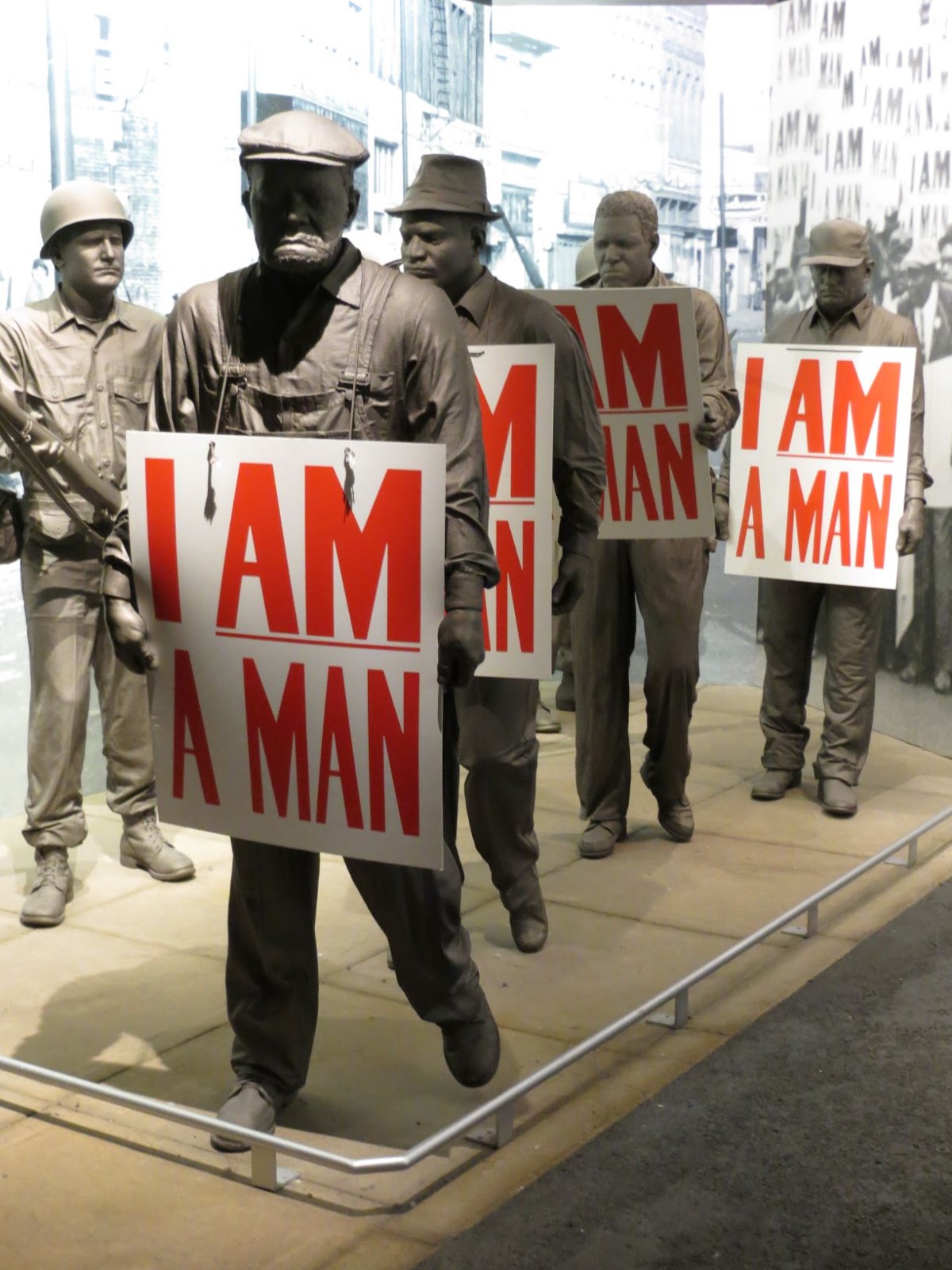
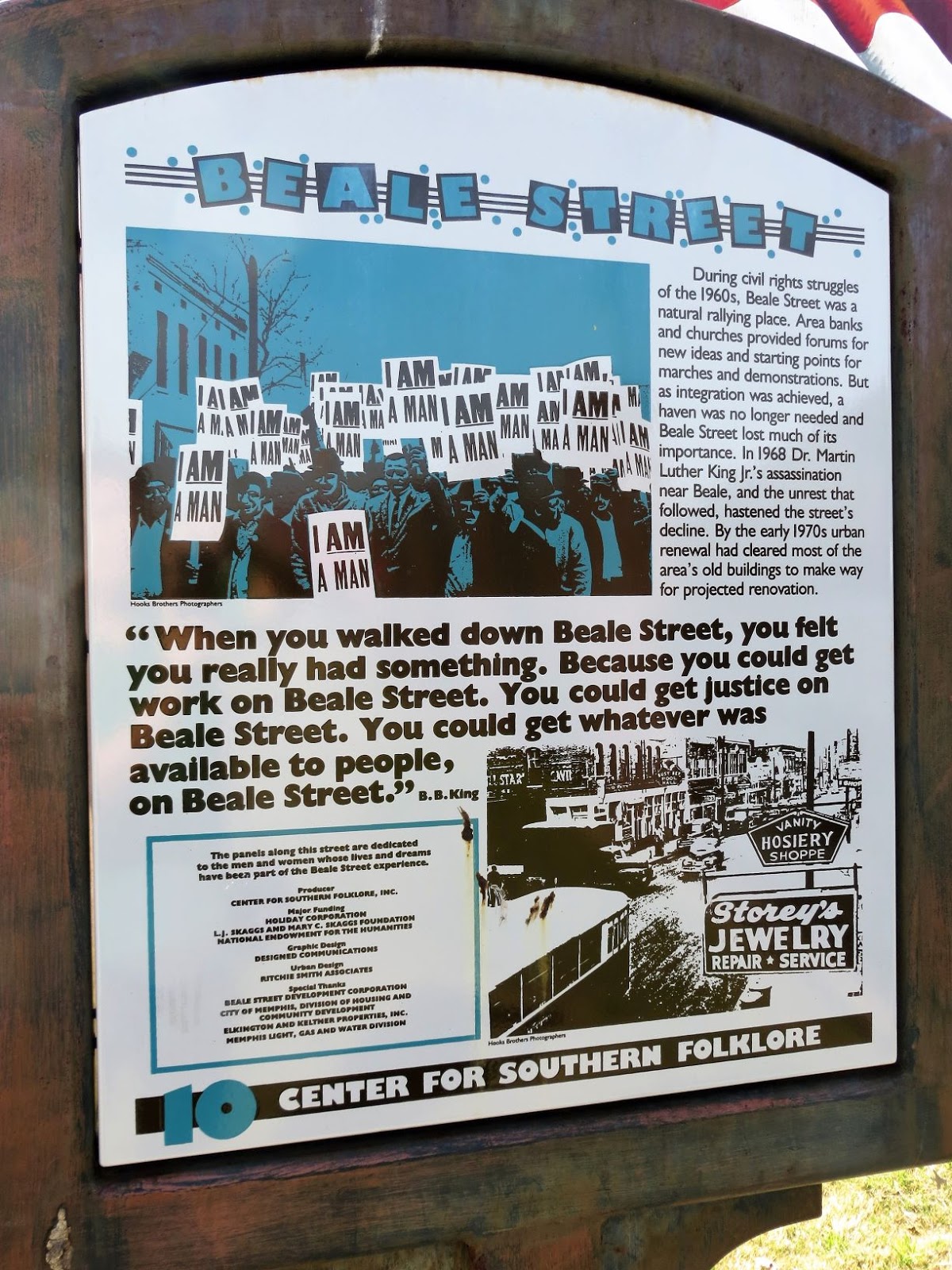
There were also exhibits about other protests: "I Am A Man," and the "March on Washington (D.C.)." The March on Washington featured his famous "I Had a Dream" speech at the end of it. The "I Am A Man" march was in support of the sanitation workers in 1968.
We continued through the museum which eventually wends its way to the room of the Lorraine Motel where Martin Luther King, Jr., was staying. We learn he was out on his balcony in the evening chatting with friends when the bullet hit him. He dropped to the ground and never said another word. This was a totally senseless killing.
 |
Room #306 where Dr. Martin Luther King, Jr.
was staying before he was murdered. |
Across the street from the Lorraine Motel is more of the museum. This section is dedicated to Dr. King's last days, how the shooting happened, the assassination trial, conspiracy theories about who killed him or had him killed, and the continuation of King's vision for a Poor People's Campaign.
 |
| The window from whence the fatal shot was fired. |
Our day so far is very informative. Now we are going to do some exploration. We drove close to Beale Street and the Peabody Hotel, paid a parking meter for two hours, and took off on foot. First, we had to find lunch. There was an Aldo's Pizza Pies in downtown and it sounded good. We each had a slice of their Daily Special Pizza which ended up being very good.
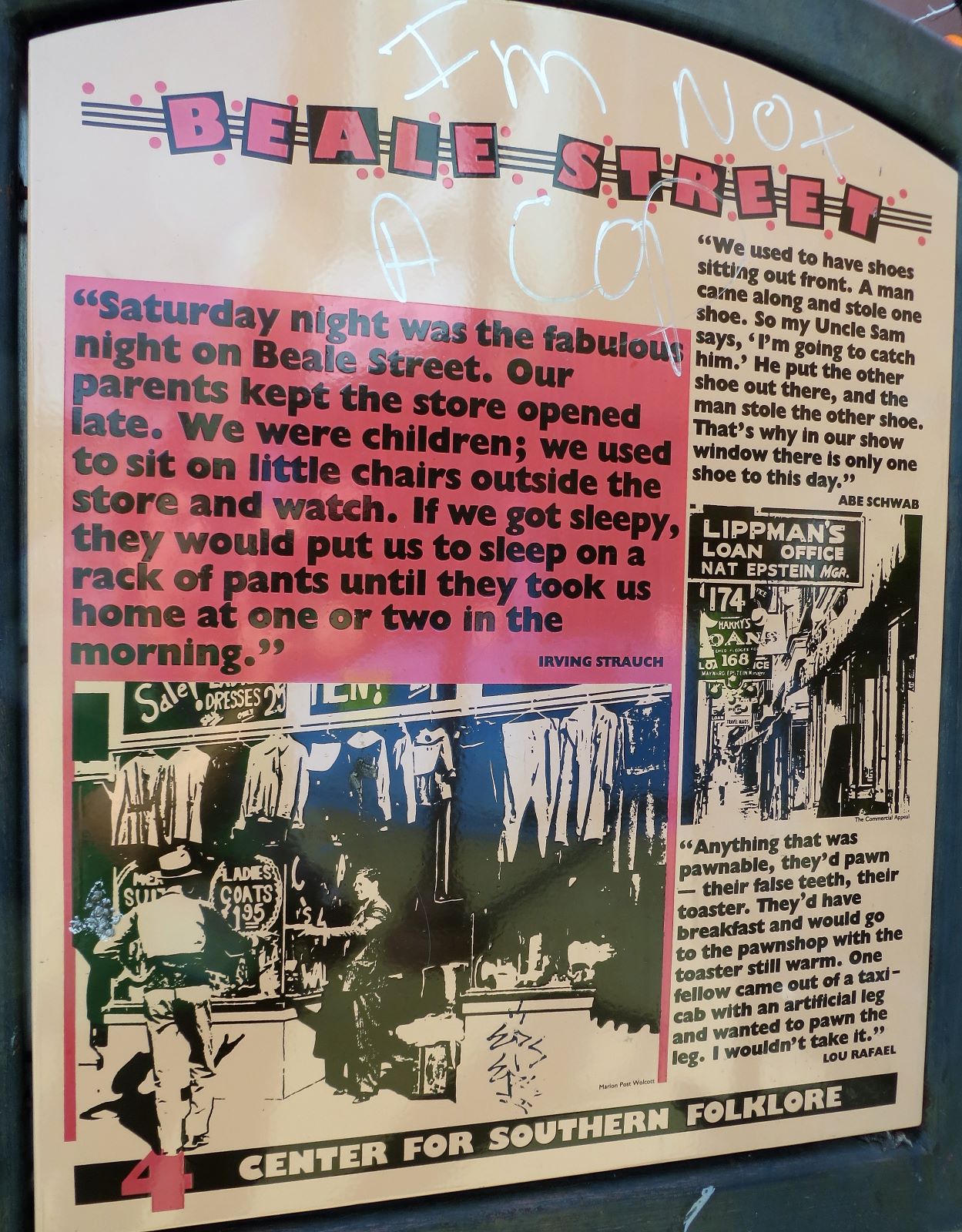
Beale Street was on our list, so we headed that direction. Beale Street was where the blues got their start with W. C. Handy. Here are some impressions of the Beale Street area.
 |
| Voted top ribs in Memphis. |
I really wanted to see the beer-swilling goats at Silky O'Sullivan's bar, but according to a waiter PETA made them stop. We did not get to see the goats dive off the tower, either. I wonder if they only did that after swilling beer? LOL.
 |
| The diving tower. |
 |
| One of the goats. |
W. C. Handy was the Father of the Blues and there's a plaza dedicated to him on Beale Street. In the first photo below, you can sort of see the statue of W. C. Handy to the right of the guitar.
 |
| Guitar says, "All roads lead to Memphis." |
 |
| I DO love Memphis! |
 |
| Jerry Lee Lewis' restaurant. |
 |
| Me showing how big the Beale Street gateway is. |
 |
| Roof on the police station. |
 |
| Memphis home of W. C. Handy. |
From Beale Street, it was only a three block walk to the Peabody Hotel where I wanted to see the world-famous Peabody ducks do their walk from the fountain to the elevator. They take the elevator twice a day: once to come down from the roof and then at the end of the day to go back to their rooftop penthouse.
We learned that the Peabody ducks are wild ducks who spend three months at the hotel and they are released back into the wild and new ducks are brought in.
We were told to get there at least 35 minutes early. Since they were scheduled to go to the elevator at 5:00 p.m., we got there at 4:25 p.m. Seating in the bar to see the ducks was already full. I found a spot near the ducks' red-carpet walkway to the elevator.
 |
| The ducks in the lobby fountain. |
 |
| The lovely lobby in the Peabody Hotel. |
At 4:55, the Peabody Duckmaster announced that the ducks would be starting their "walk" shortly and he rolled out the red carpet. He named two girls honorary duckmasters and shortly thereafter the ducks climbed out of the fountain and walked to the elevator. I loved it.
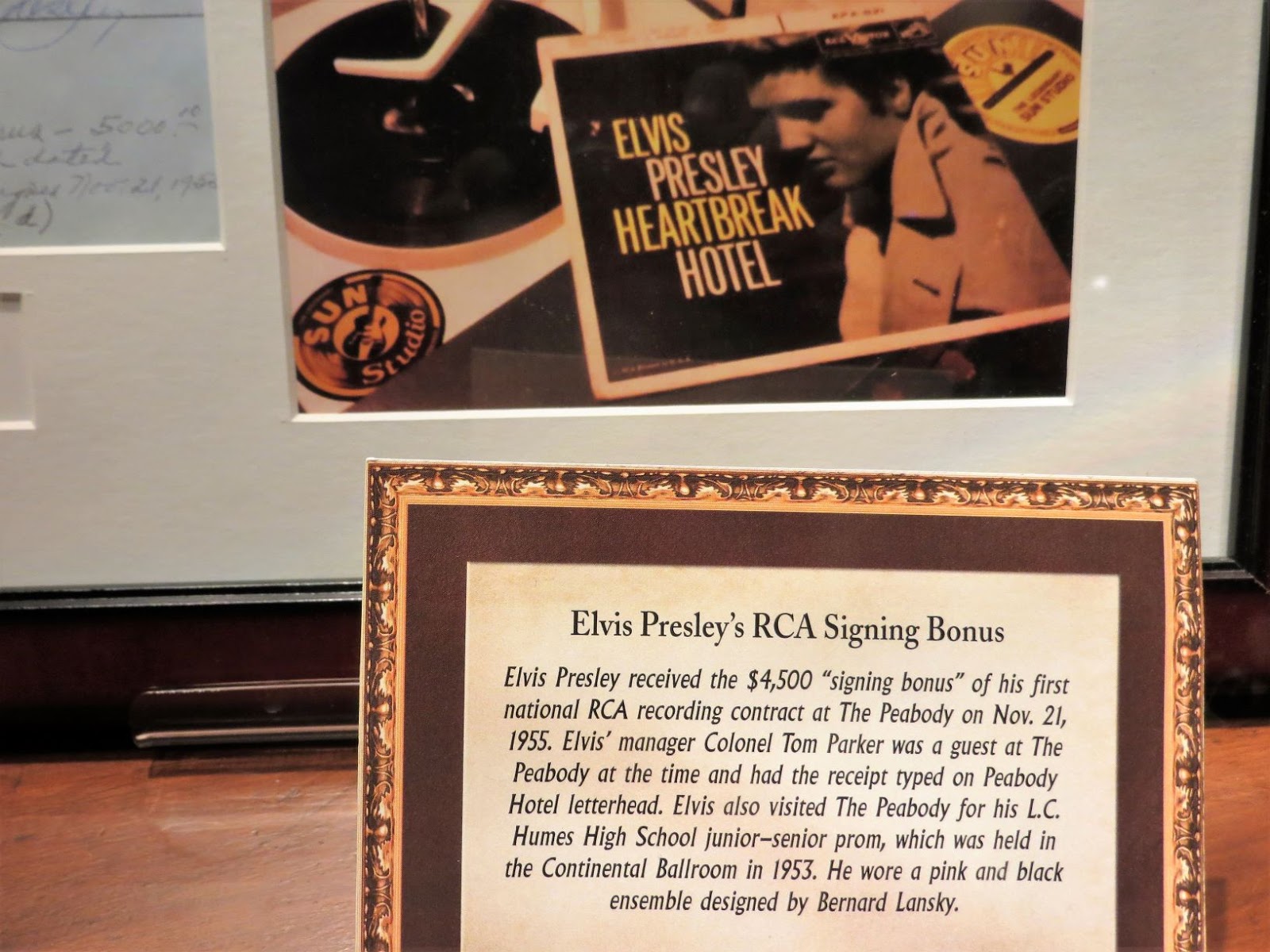
After the duck brigade parade, we went up to the Mezzanine and looked at the Peabody duck memorabilia in a small room.
 |
| Elvis Presley history here. |
 |
| The first Duckmaster. |
 |
| Photo of the first Duckmaster. |
Early on in the history of the Peabody Hotel, one of the chefs wanted to put duck on the menu. That was not to be!
 |
| No dead ducks at the Peabody. |
Walking back to the truck, we passed a painted panther, an Elvis statue, and Lansky Brothers, "Clothier to the King."
 |
| Elvis sculpture. |
While we had good weather, we wanted to do the two-mile roundtrip walk across the Mississippi River, AKA the Big Muddy, at the Big River Crossing. The walk was very enjoyable!
 |
| Big River Crossing Park |
 |
Entrance to biking/walking/jogging path over
the Mississippi River to West Memphis, Arkansas. |
 |
| View of the Mississippi and downtown Memphis, TN. |
 |
| Downtown Memphis, Tennessee. |
 |
| We made it across to West Memphis, Arkansas. |
We were supposed to camp at Tom Sawyer RV Park with a riverfront pull-through site where we could see the barges going by. It wasn't meant to be this trip because the Mississippi River flooded the campground. (It happens regularly.)
 |
| A train heading across the bridge. |
 |
| And then a barge went under us. |
We wrapped up our Memphis tour day with a visit to the top of the Bass Pro Shops Pyramid. Yes, we rode the free-standing elevator to the top to watch the sunset. We decided not to have dinner there. The views are worth the price of admission.
 |
| Downtown Memphis at sunset. |
 |
| The Mighty Mississippi. |
 |
Steampunk fish hanging from the restaurant's
ceiling. |
 |
| The Mississippi River Bridge lights up at night. |
 |
| A beautiful sunset to cap off a pretty day. |
 |
| Overlooking downtown Memphis and The Big Muddy. |
 |
| It just keeps getting better! |
 |
| Time to call it a day! |
A very busy day for us. We walked seven miles. It was a blast. Memphis has a lot to offer.