Cliff jumper, South Point, Na'alehu, Big Island - Monday, March 10, 2025

Cliff jumper, South Point, Na'alehu, Big Island - Monday, March 10, 2025

Sunday, April 7, 2019

Sunday at Sun Studio - April 7, 2019

With all the hype surrounding Sun Studio, you'd think it would be a large place. Not so. In fact, of all the places we saw, this was the least interesting. Overall, not including the cafe, it was three rooms. 


Bob outside Sun Studio
Historical marker in front of Sun Studio.
Need to find Sun Studio?
Look for the huge guitar!

No tour time was specified on our ticket. Upon arrival, we were rushed up the stairs to join a tour that was already in progress. The room was small and looked in poor repair. The floor seemed like it could collapse from all the people crammed in there. 

Our tour guide was trying way too hard to be likable/enthusiastic/personable and sounded like he had the same script on every tour. I don't know how much we had missed. We heard him talk about five minutes, giving us a history of "Daddy-O" Dewey Phillips, a young man who was hired by WHBQ radio after he dropped out of Memphis College of Music. 


Dewey "Daddy-O" Phillips Control Room C where
he smashed records on the floor that he didn't like.
Daddy-O wowed his audiences with his passion for rhythm and blues. He helped launch the careers of Elvis Presley, B.B. King, Jerry Lee Lewis, Johnny Cash, Roy Orbison, Carl Perkins, and my others. When he played records, if he didn't like the music, he would literally shatter the record on the floor of Control Room C. 

Our guide then gave us about 15 minutes to look in the exhibits lining the room. There were so many people that it was hard to see and read the exhibits.


Remember these tape recorders?
B.B. King memorabilia.
From this room, we headed downstairs where we had a very brief talk about this room that was used as the business office. He brushed off this room and took us immediately into the recording studio. 


The business office of Sun Recording Studio.
Our third room was the actual recording studio. He gave us the history of the room, told us all the famous faces who came here to record and then let us loose to take photos of everything in the room, including the microphone Elvis Presley used. Ooooh, big whoop.


The Million Dollar Quartet: Elvis Presley,
Jerry Lee Lewis, Carl Perkins, and Johnny Cash.
Guitars used by artists
who recorded here.
One of U2's drum sets.
I'd listen to this handsome man sing!
We were goofing around.
My turn to rock.
The tour was over after a half hour and our guide asked for tips. We then were shown to the gift shop/cafe.


A beautiful stained glass piece near the ceiling.
Cafe and gift shop.
Enlarge to read.
An old LP made into a work of art.
A mural at a building next to Sun Studio.
We thought about parking here but decided against it after reading the sign below. No other cars were parked in front of this business.


We thought the Sun Studio tour was rather forgettable and don't recommend it.

A couple of blocks away is the Victorian Village National Historic Neighborhood. While it has beautiful buildings, as you will see below, it is not a neighborhood we would walk through. It was very seedy with many homeless populating the park. One man was lying on a sidewalk. He didn't look like he was doing very well. At first, there was one police car there, by the time we drove around the block, there were five police cars and a fire truck...for one guy.

Here are the buildings in Victorian Village...

The James Lee House.
Woodruff-Fontaine House, 1871.


Mallory-Neely House, circa 1852, a 25-room,
Italian villa-style mansion. It's now a museum.
Christian Brothers College purchased this
Memphis Female College in 1871.
St. Mary's Cathedral College and Diocesan House.
St. Mary's Cathedral College and Diocesan House-
front view.
Lowenstein Mansion - side view.
Lowenstein Mansion - front view -
1891 Victorian Romanesque residence.
We finished our activities for the day by returning to Makeda's Butter Cookies. She is closed on Sunday but told us to check back this afternoon because she might be in. We found her in front of her shop talking to some British visitors who were asking if she was open. She was waffling on opening until we came up and asked her to please open, too. We convinced her and were able to get more banana pudding. We were very happy and so were the Brits. I think she was too because she had two customers in five minutes. She even threw in three small packages of her butter cookies! Great lady.

We then made our way back to the 5th wheel to get ready for our travel day to Nashville tomorrow.

Saturday, April 6, 2019

Stax Museum of American Soul Music in Memphis, Tennessee - Saturday, April 6, 2019

Today's outing is all about the origin of soul music in America. We're visiting Stax Museum of American Soul Music. Our time in Memphis is a full immersion into Civil Rights, blues, soul, rock 'n' roll, slavery, and how they all relate.

On the way into Memphis, we took a detour to check out T.O. Fuller State Park. It was a reconnaissance mission more than anything. The camping area at the park is beautiful, located in a forest. We didn't stay there, so we can't attest to how level the sites are. The park facilities were originally built for African-Americans during the Great Depression by the Civilian Conservation Corps. It was the second state park in the USA that was open to African Americans.

During excavation for a proposed swimming pool at the park in 1940, CCC workers exposed evidence of a prehistoric village. The University of Tennessee initiated archeological excavations of this Mississippian mound complex in 1940. The site has since been developed as Chucalissa Indian Village and includes preserved archeological excavations and the C.H. Nash Museum at Chucalissa. The facility is currently operated by the University of Memphis. We did not go to the museum.


At Stax Museum of American Soul Music, we gathered in their lobby with a group of other visitors to the museum for a short intro to the birth of soul music and how the museum came to be. Then we were guided into a small theater for a short film showing soul singers performing. Bob and I stood in the back because it was hard to see through the people in front of us. I was dancing 'cuz I couldn't help it.

After the movie, the doors opened and we were released into the museum. The first exhibits were about the influence of gospel singers on soul music. 
"Of all the musical styles on which soul music is built, the two most prominent are gospel and blues. Both are expressions from the human heart of love, pain, and longing. Gospel is church-based and sung to God, while blues is secular and often sung to another person--often a spouse or lover, present or former. Both musical forms release the participants from their immediate confines, offering refuge for the spirit." [From an exhibit in the museum.]
Spirituals were another early form of music, pre-dating gospel music. These began during slavery and were therapy in the midst of a painful experience. Other names for spirituals included field songs, cabin songs, and folk music. Gospel music developed around the 1930s.

In the 1950s, the Civil Rights movement was interconnected to the black church. The church which was a place for exchanging ideas, helped the Civil Rights movement grow. Dr. Martin Luther King, Jr., who still preached in his home church, traveled the country to promote non-violent protests.

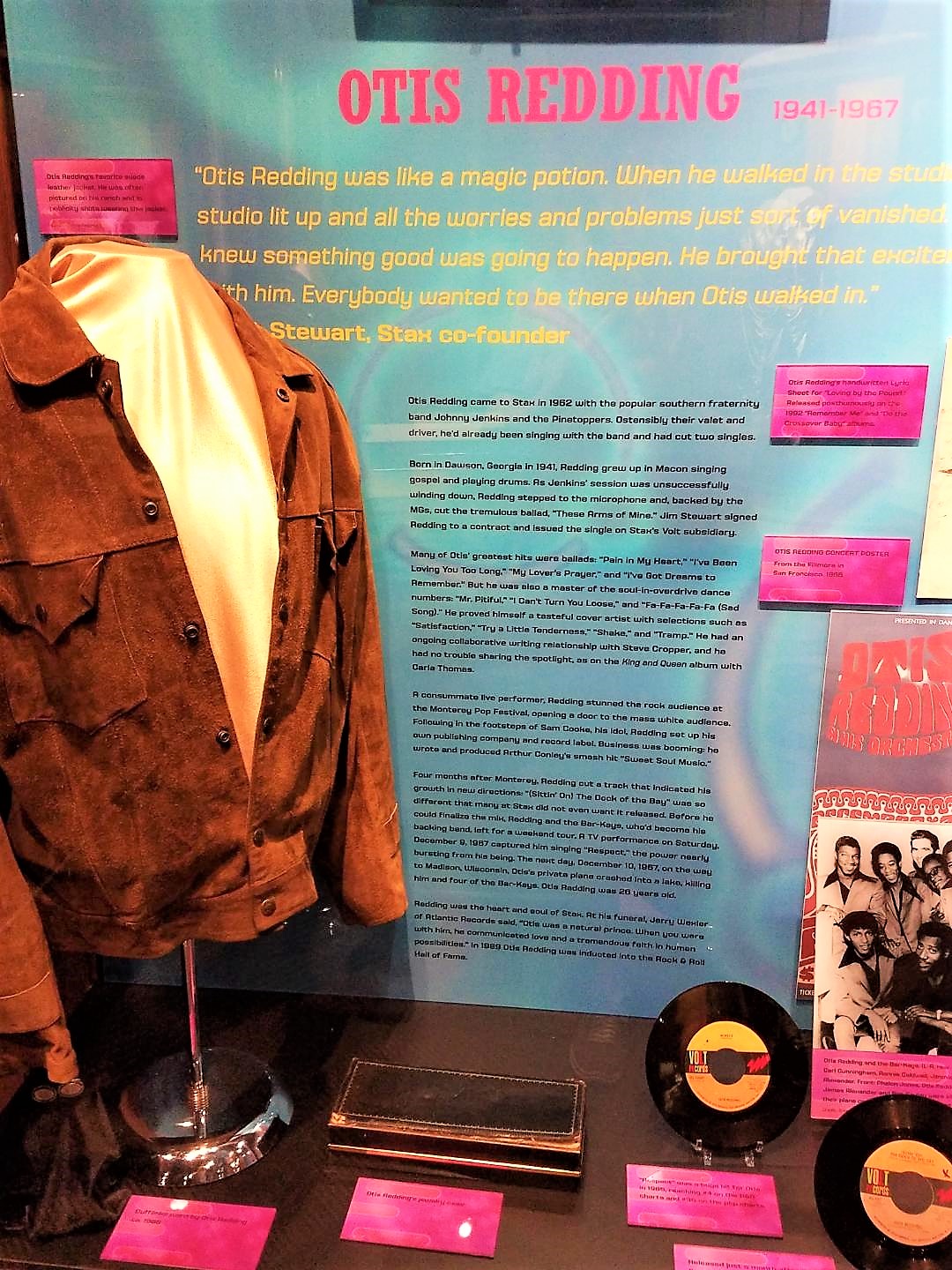
In the 1960s, soul records like Otis Redding's "Respect" and Sam & Dave's "Soul Man" became anthems of black pride. Aretha Franklin's "R-E-S-P-E-C-T" became a feminist statement.

Out of all these things, gospel developed into the blues, which morphed into soul music. The blues music was rawer and came from hardship. Like spirituals, the blues offered release and relief. Soul music was a smoother sound and has been referred to as gospel music with secular lyrics. James Brown, Ray Charles, and Sam Cooke helped bridge the music from gospel to rhythm and blues. Into the late 1950s, Ray Charles innovative blend of gospel and rhythm & blues helped develop the foundation for soul.

One exhibit explains soul like this, "Soul music is a groove, and a groove makes you move, fast or slow, swaying with your baby...Soul stirs your insides and shakes your outsides."

Stax had a unique atmosphere among its ranks of musicians. The integrated band Booker T and the MGs (two black, two white) played for years at Stax as part of many musicians' back-up band. The staff and musicians at Stax were integrated, not segregated. All of them loved going to work there as they felt everyone was there for the music and skin color didn't matter. 


Booker T and the MGs display.


All that changed when Martin Luther King, Jr. was assassinated. Some of the artists developed a distrust of each other and it was never the same again (which is a total shame).

I hope you can enlarge and read the photo below because it really characterizes the spirit of Stax music before MLK, Jr.'s assassination.


At Stax, an old movie theater had been repurposed into a sound stage. The sloping floor was not leveled, and that gave a whole new sound when making the music. Stax music was simple and spare. When Motown started up in Detroit, Motown developed "a lush wall of sound."

Here are some photos of the sound stage area...


Control room looking into the sound stage.
Drum set of Al Jackson, Jr.
The inside of the recording studio.
Me listening to some Black Cat Blues.
Isaac Hayes was one of the huge stars that came out of Stax Studios. He was hot and he knew it. During his career, he won not only a Grammy but an Academy Award.
Isaac Hayes display.
More Isaac Hayes memorabilia.
Isaac Hayes' car and Academy Award.
(The car has real gold accents!)
Close-up of the car; it even has white fur carpet.
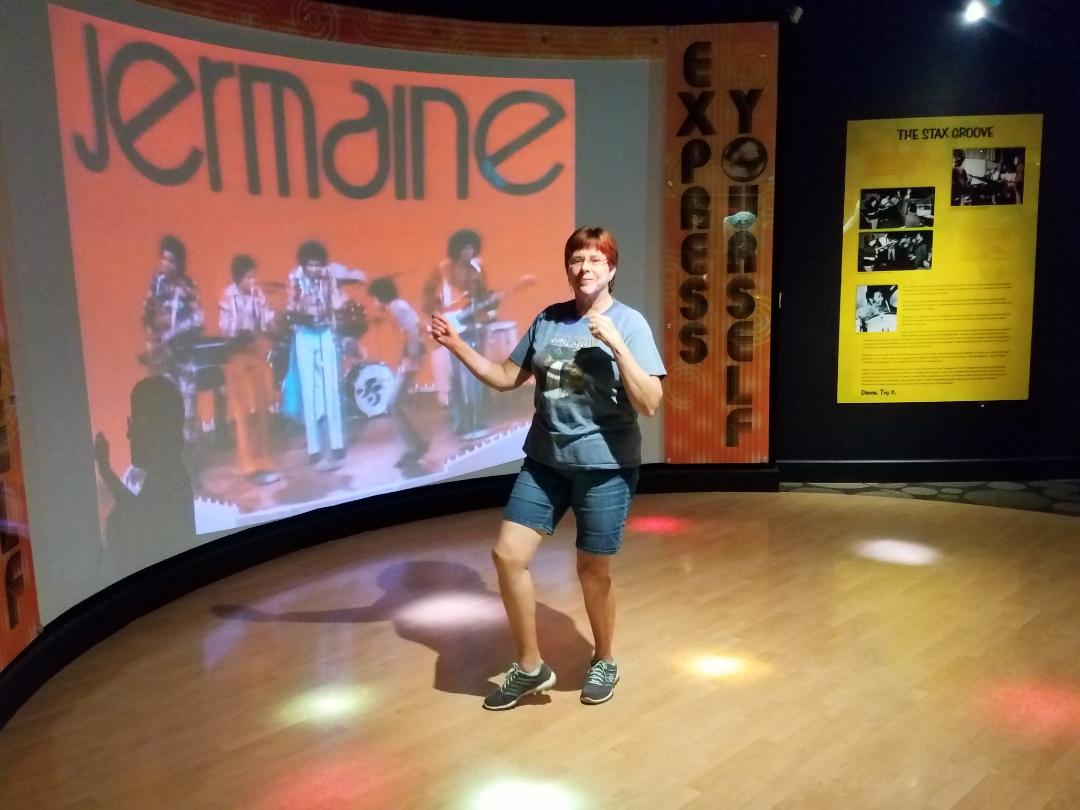
Over the years, other artists who visited or recorded at Stax were Janis Joplin, Elton John, The Monkees, Led Zeppelin, ZZ Top, Leon Russell, Otis Redding, Blues Brothers, The Box Tops, James Taylor, and Elvis Presley. Brian Epstein, the Beatles manager, looked into recording at Stax. However, word got out and teenage girls brought Beatlemania to the studio's front door which nixed the Beatles' plans.There were some fun interactive exhibits. One was a dance floor called "Express Yourself." Soul music played continuously and there was a disco mirror ball. I couldn't stand still.
Me expressing myself to the music. (I got a
free sticker and pen for posting it on social media.)

The demise of Stax Studios was very sad. A series of unfortunate events led to its untimely end. 

The whole museum was very well done. A wealth of information lives inside just waiting to be found. We highly recommend this museum.


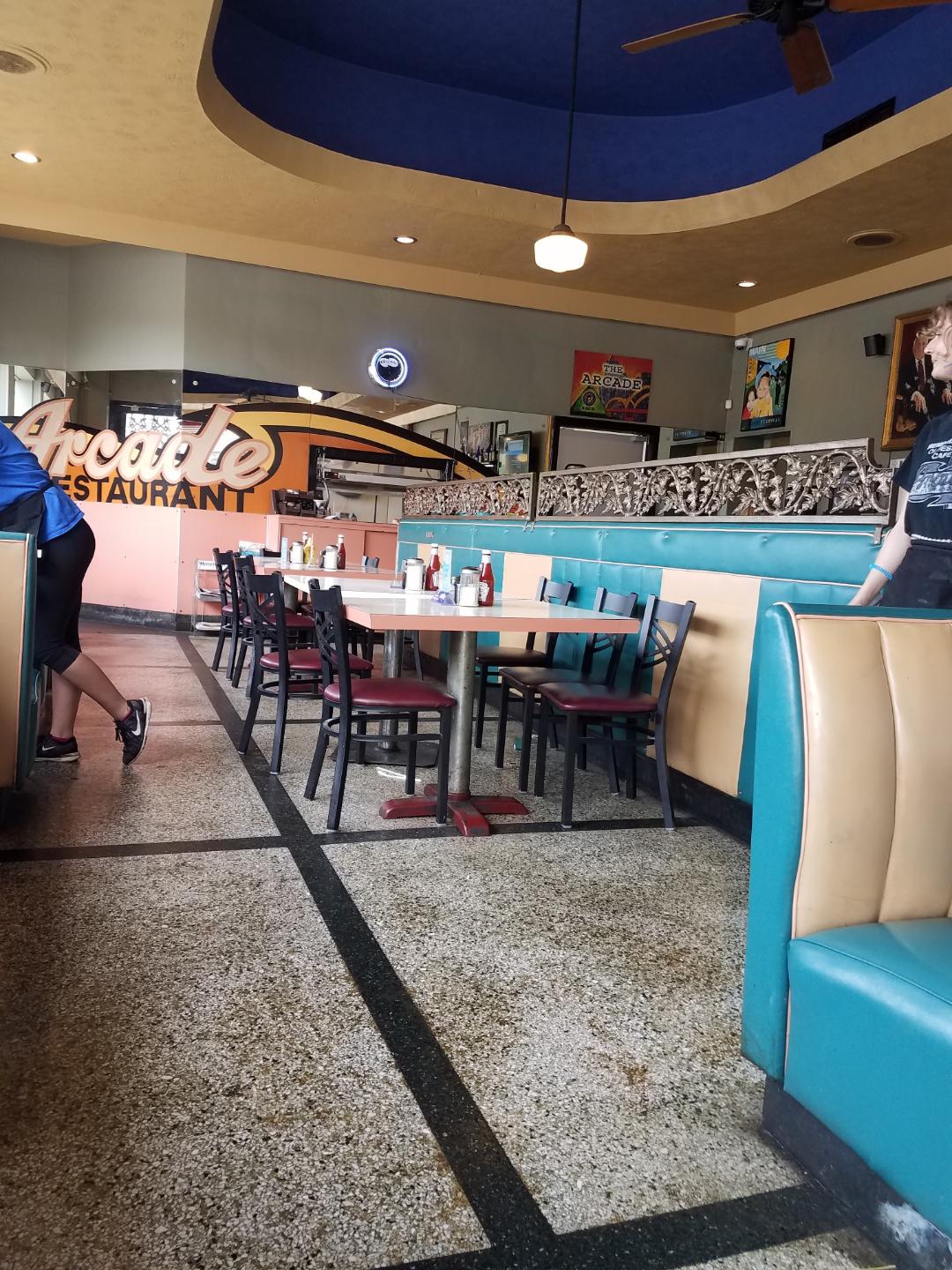
After our time at Stax, we went to the Arcade Restaurant for lunch. Elvis Presley used to frequent the place. It's a very retro diner, but the food was impressive! I had a 1/2 salad and 1/2 sandwich. I was able to choose from a few salad and sandwich choices. The Summer Salad with fresh strawberries and grapes was excellent. I had a club sandwich which was also yummy. Bob enjoyed his catfish Po-boy and potato salad. (I helped him enjoy his homemade potato salad. Mm!)

The Arcade Restaurant.
Retro menu.
Summer Salad and Club Sandwich.
After lunch, we made a beeline to a cookie shop we had seen on the day we toured the Civil Rights Museum/Lorraine Motel. It's called Makeda's Homemade  Butter Cookies. But that's not all they sell there. No, sirree. They have the absolute best Banana Pudding I've ever had. We shared a Banana Pudding and got a couple of cookies to go. If you go to Memphis, don't miss this place! Currently, it is not open on Sundays, but she's thinking about it. She says she's missing too much business from the Civil Rights Museum.


Makeda's storefront.
Makeda's interior.
Our yummy Banana Pudding. OMG!
Celebrating their 20th year.
The crew at Makeda's, including the
Cookie Monster hiding in the back.
Their cookie display case.
Award for best, you guessed it,
Banana Pudding.
But wait, our day isn't quite over yet. I was interested in seeing Slavehaven. We drove over and scoped it out. We arrived at 4:00 p.m., but they were closing in one-half hour, so we did not go in. We may do it on a future visit...we'll see.


On the way back to EZ Daze RV Park, we stopped at the Visitor Center (which wasn't open). But, we did walk around the pond at De Soto County Veterans Park where they had memorials for every war the U.S. has been involved in. It was very nicely done.


At the RV park, we were relaxing knowing that a severe weather warning was in effect around 9:00 p.m. Sure enough, at 9:15 p.m. our phones went off with the warning to take shelter. Then the tornado siren at the park went off. We put Sunnie in his carrier and grabbed our go-box with important papers and computers and drove across the street to the shelter. 

We were in the shelter maybe 15 minutes when the all-clear was given. Bob immediately wanted to go back to the 5th wheel. I nixed that idea when I walked outside and saw the sky white with lightning and you could see the rain going sideways in sheets. Nope, I wasn't going out in that. We waited about ten more minutes and even though there was still lightning, Bob insisted that we go. Ugh. I don't like being out in rain and lightning with my umbrella that has a metal tip!

We made it into the rig safely and endured another half-hour or so of thunder, rain, lightning, and wind. Tornado warnings give me the heebie-jeebies!

That is finally the end of our day!