Museums come in all types: art, science, technology, inventions, history, geology, you name it. You never know what a museum holds until you step onto its grounds, explore its exhibits, and open your curious mind to what you find inside. Websites give information about what you will see, but typically you will discover more than you thought. We experienced this today at the American Windmill Museum AKA The American Wind Power Center.
The American Windmill Museum is the largest windmill museum in the world. It sits on 28 acres of city parkland east of Lubbock, Texas. The hours are Tuesday through Saturday, 10 am to 5 pm; closed Sunday and Monday.
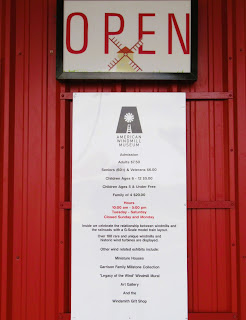 |
| There's all this and more! |
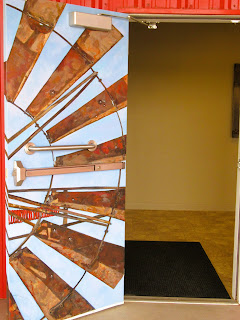 |
| Windmill art on the entry door! |
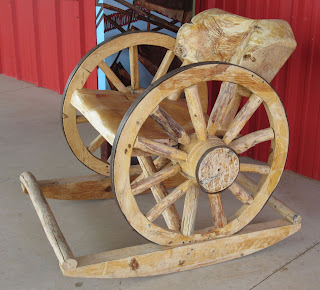 |
A hand-carved rocking chair decorated
with a roadrunner. |
We arrived at 10:30 am and entered the building to pay, but no one was at the reception window. After helping ourselves to a snack-size piece of candy and a small bottle of water, we picked up the brochures on the table and signed the guest book. The windmill exhibits outside looked inviting, so we checked them out. We'd go in and pay when we came back around to the front.
The outside exhibits are what convinced us we had to come to this museum when we saw the grounds a year ago. It was too late in the day for us to visit then. Now we have returned!
"How does a windmill work? The windmill is erected on a tall tower above any obstructing objects like trees or houses. When the wind hits the wheel, it begins to turn gears inside the gearbox which changes the rotating motion of the wheel into an up-and-down pump stroke. A wooden sucker rod connects the gears to a pump cylinder located at the bottom of the well. Water is then lifted to the surface where it can be stored in stock tanks or in domestic water tanks. The tail on the windmill points the wheel into the wind."
Things to notice on the windmills:
- Unique color schemes for each windmill manufacturing company.
- Orienting tails (with or without advertising as shown below).
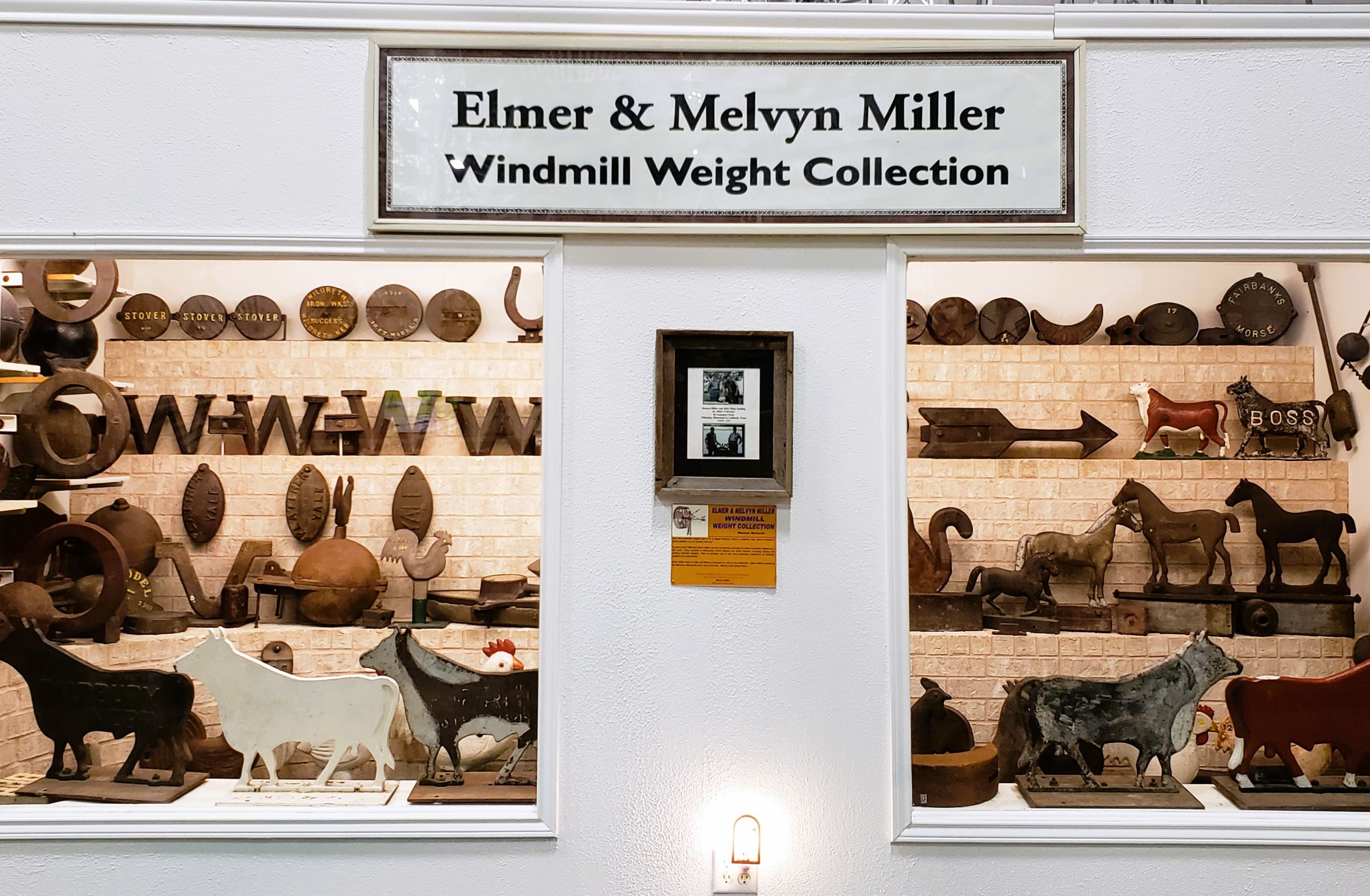
- Windmill weights for windmills without orienting tails could be
- distinctive figure weights [there will be photos below],
- governing weights, or
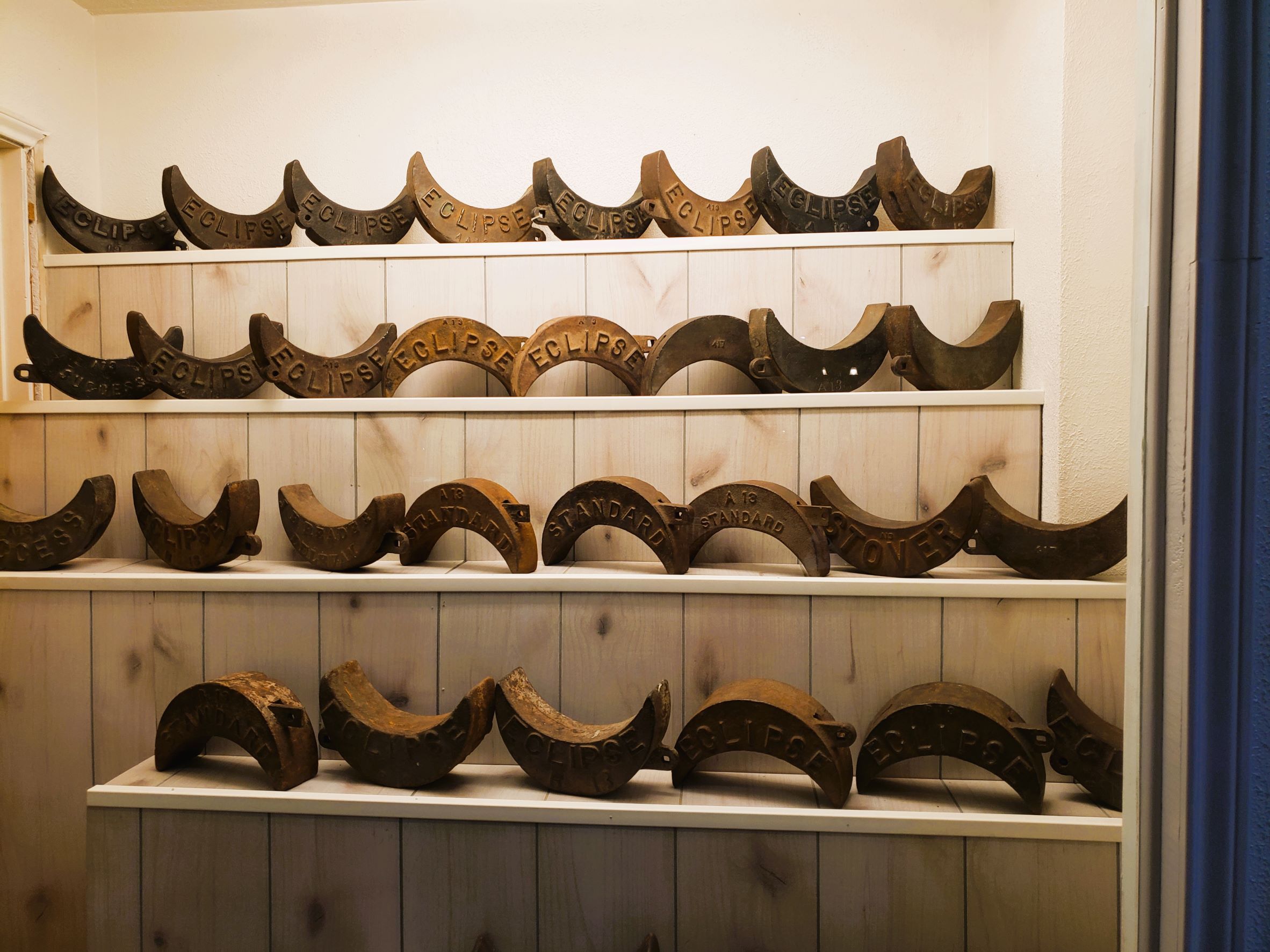
- crescent weights (with the tips pointing up) [there will be photos in Part 2].
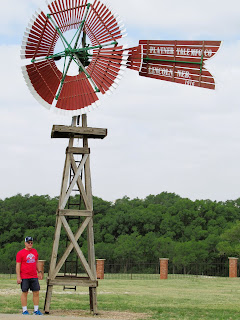 |
Bob at the base of a Platner-
Yale Mfg. Co. windmill from
Lincoln, Nebraska (1916). |
 |
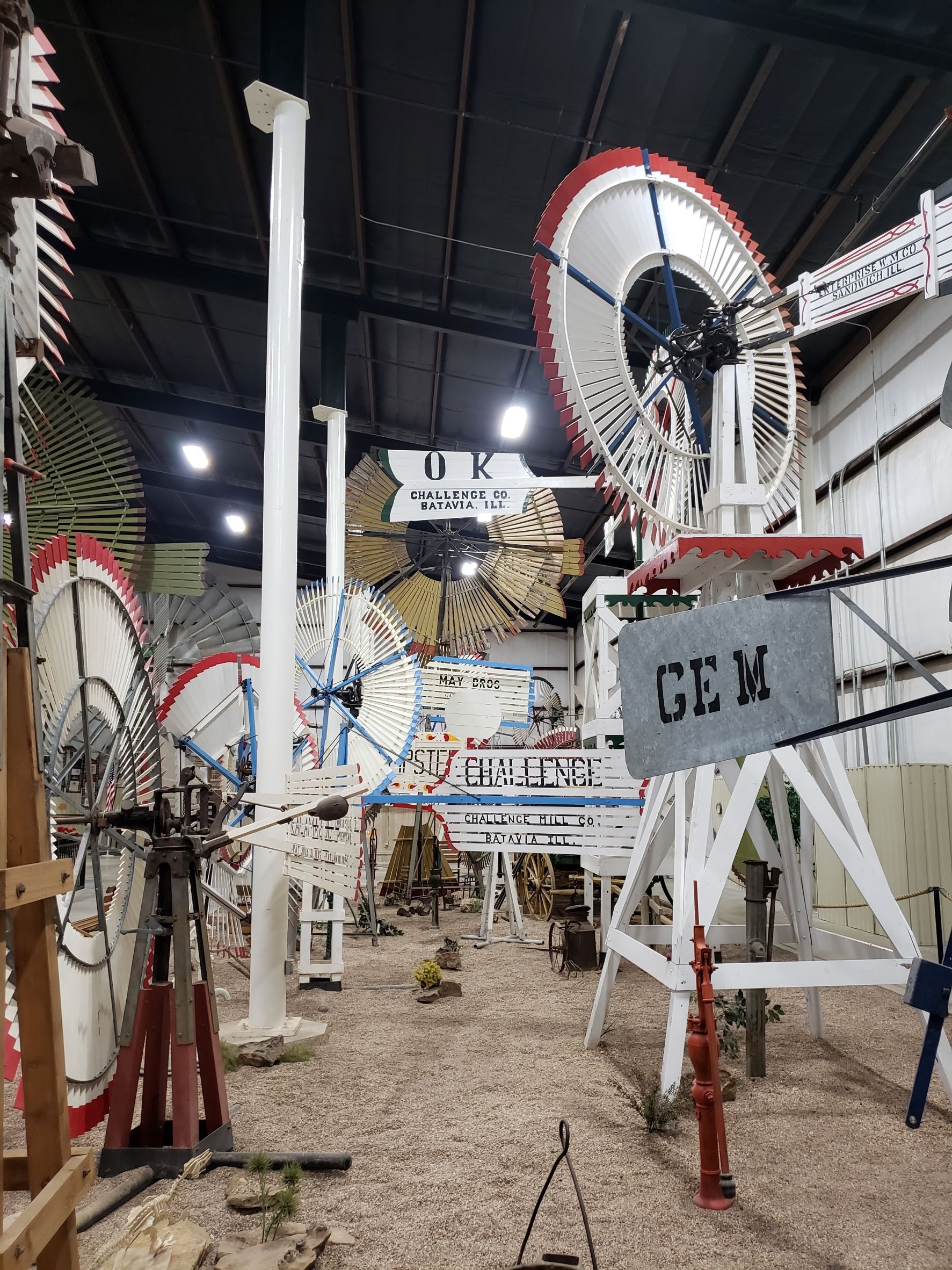
| A cluster of windmills. |
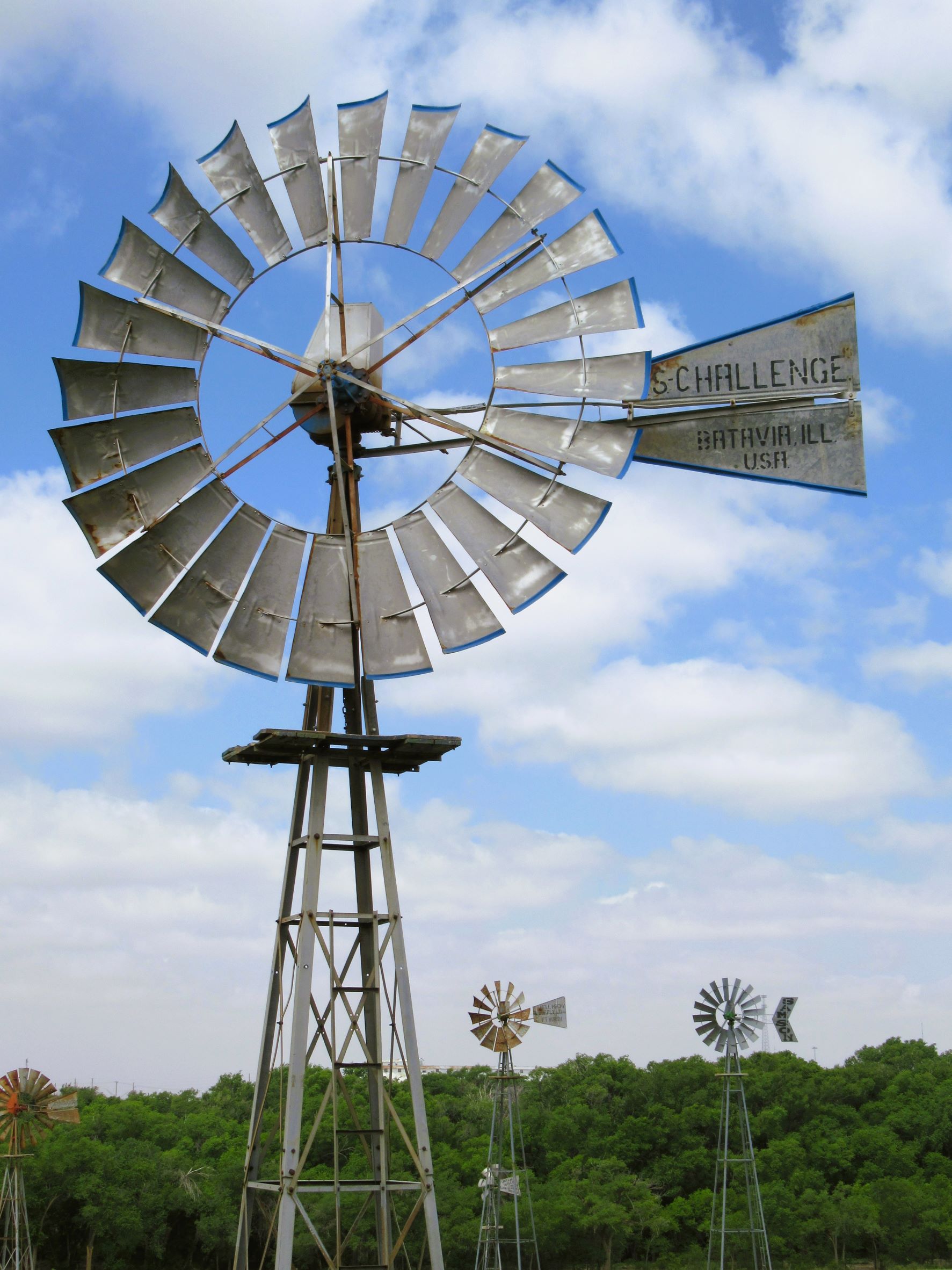
"Challenge windmills: Challenge made and sold thousands of the Model 27 windmills on the Great Plains. Big windmills, like this 20-ft. model, pumped water for large cow herds in Texas. The wheel mounted on a 4,000-pound gearbox and stood on a 40-ft. steel tower."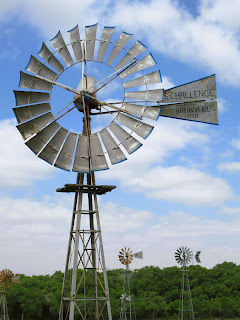 |
| S-Challenge, Batavia, Illinois. |
Vestas V47 statistics: The wheel is 155 ft. in diameter. The steel tower is 165 feet in height. In the Lubbock winds this turbine, rated at 660 kilowatts, will generate over 800,000 kilowatt hours each year. The wind turbine is big enough to completely power the entire museum complex.
 |
Vestas V47 (2005), Vestas
American Wind Technology |
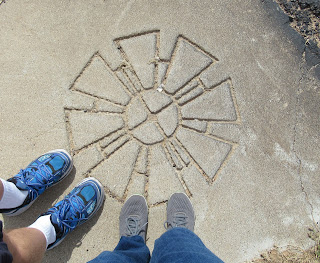 |
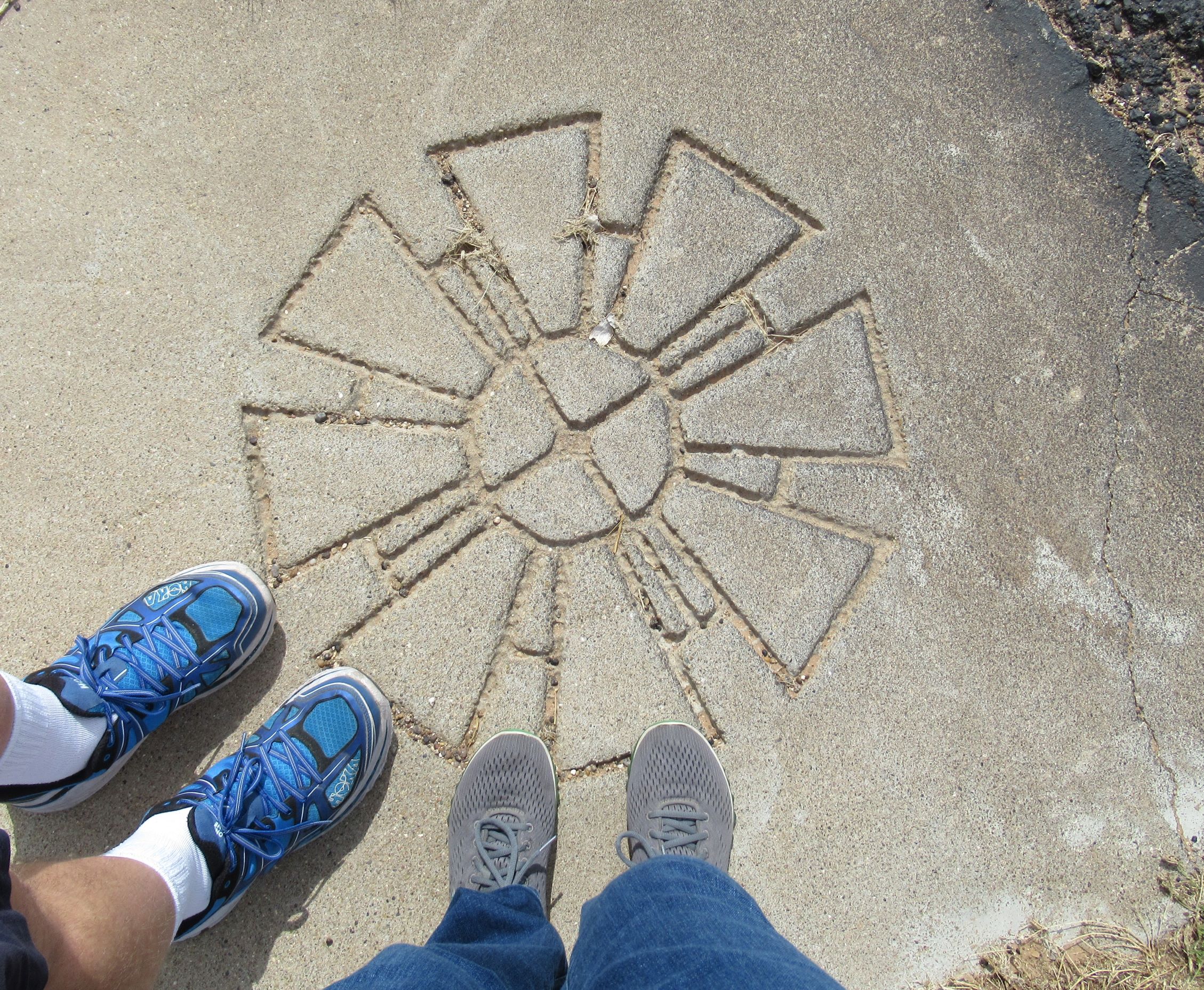
There were even windmills in the
sidewalk! |
"A 10-ft. 602 Aermotor pumps water from a well that is 127-ft. deep. The water flows through a pipe to the large stock tank just south of the Flowerdew Hundred Post Mill."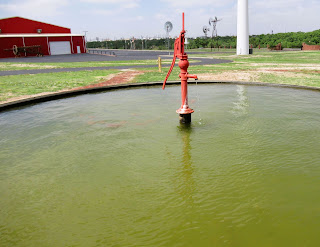 |
The large stock tank is filled with koi
and other fish. |
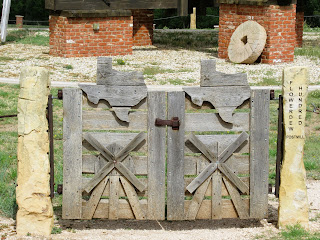 |
An awesome gate by the Flowerdew
Hundred Post Mill. |
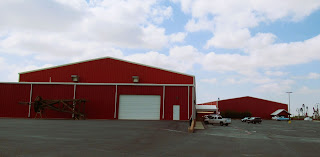 |
The two huge museum buildings that
house the exhibits. |
It's fun to explore and marvel at the huge windmills and the wind turbine on the 28 acres. New-to-us windmills included the twin-wheel windmill from 1925 and the Flowerdew Hundred Post Mill.
"A unique monopole tower (1920) was built for an Aermotor windmill by Ted Russell of Vera, Texas. He had enough money to buy the windmill, but not the tower. He used an oil field pipe for the monopole tower which had a bend in it to clear the sucker rod." (I took a video of this monopole tower working, but it didn't turn out well. You'll just have to imagine it.)
Twin-wheel (1925) from the Twin Wheel Windmill Manufacturing Company in Hutchinson, Kansas:
"The twin wheel is a very unusual American windmill. It has two 12-ft. wheels that counter-rotate and drive a single sucker rod. Advertised as 'pumping twice as much water from a single well,' these were powerful when working." In fact, an inside video about these windmills said that one small town installed a twin-wheel and within six hours it sucked their well dry!!!
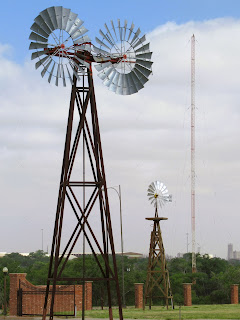 |
| Twin-wheel windmill. |
"Flowerdew Hundred Post Mill (1621): The Flowerdew Hundred is a post mill that was given to the museum by the David Harrison family of Oakville, Virginia. It was on the site where the very first windmill in North America was erected by colonists in 1621. The mill Harrison built was a modified reconstruction of that earlier 1621 windmill.
"The Flowerdew has two sets of grinding stones with each stone weighing 4,000 pounds. One pair is for corn and the other pair grinds wheat. The wheel is almost 60 ft. in diameter and is turned to face the wind with the smaller wheel at the back. Two sets of blades are cloth covered and the other pair have moveable shutters. The Flowerdew Post Mill can take care of itself in all West Texas winds."
 |
| Flowerdew Hundred Post Mill. |
Our outside tour was complete. The inside exhibits: Upon entering, we paid our admission. The docent came out from behind the counter and handed us a free, 64-page book titled, "The American Windmill Museum," copyright © 2018 by the American Windmill Museum; The Donning Company Publishers. Brief passages can be used in connection with a review. I have put those brief passages in quotes in my blog.
Bob had a phone call for work at this point. It came in just as the docent started telling us about the museum. He sat on a bench and took the call while the docent told me all kinds of interesting facts about the museum.
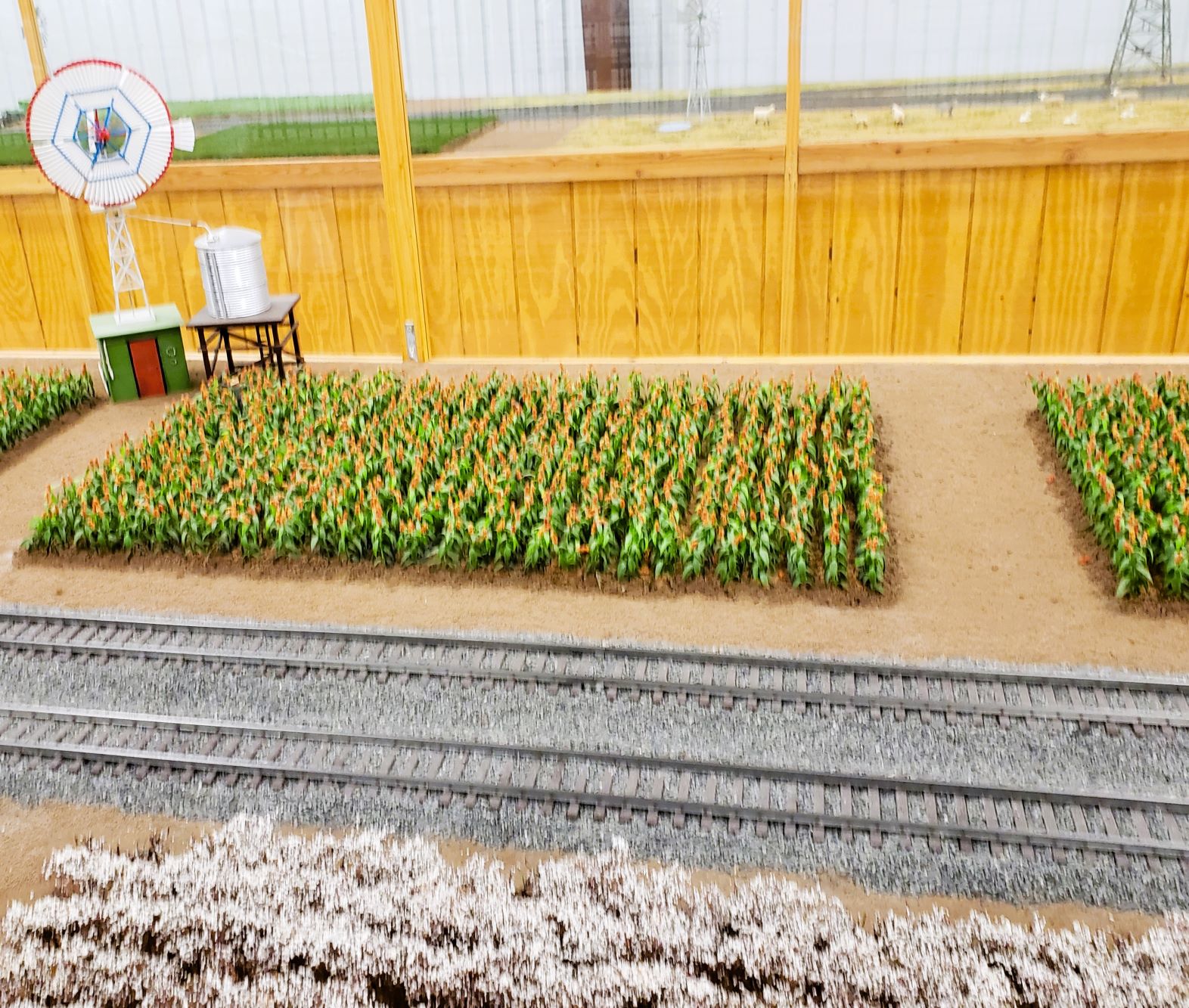
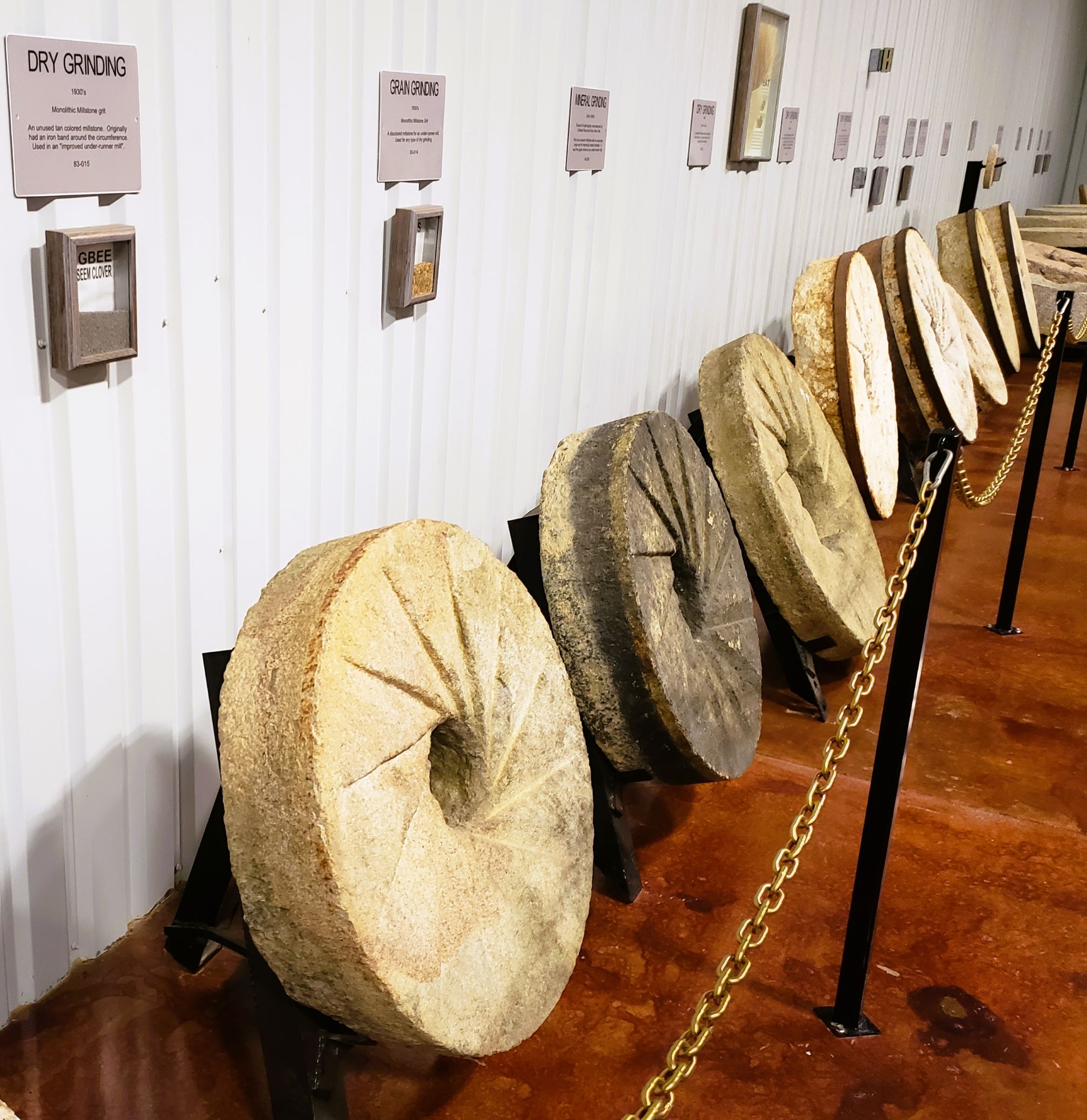
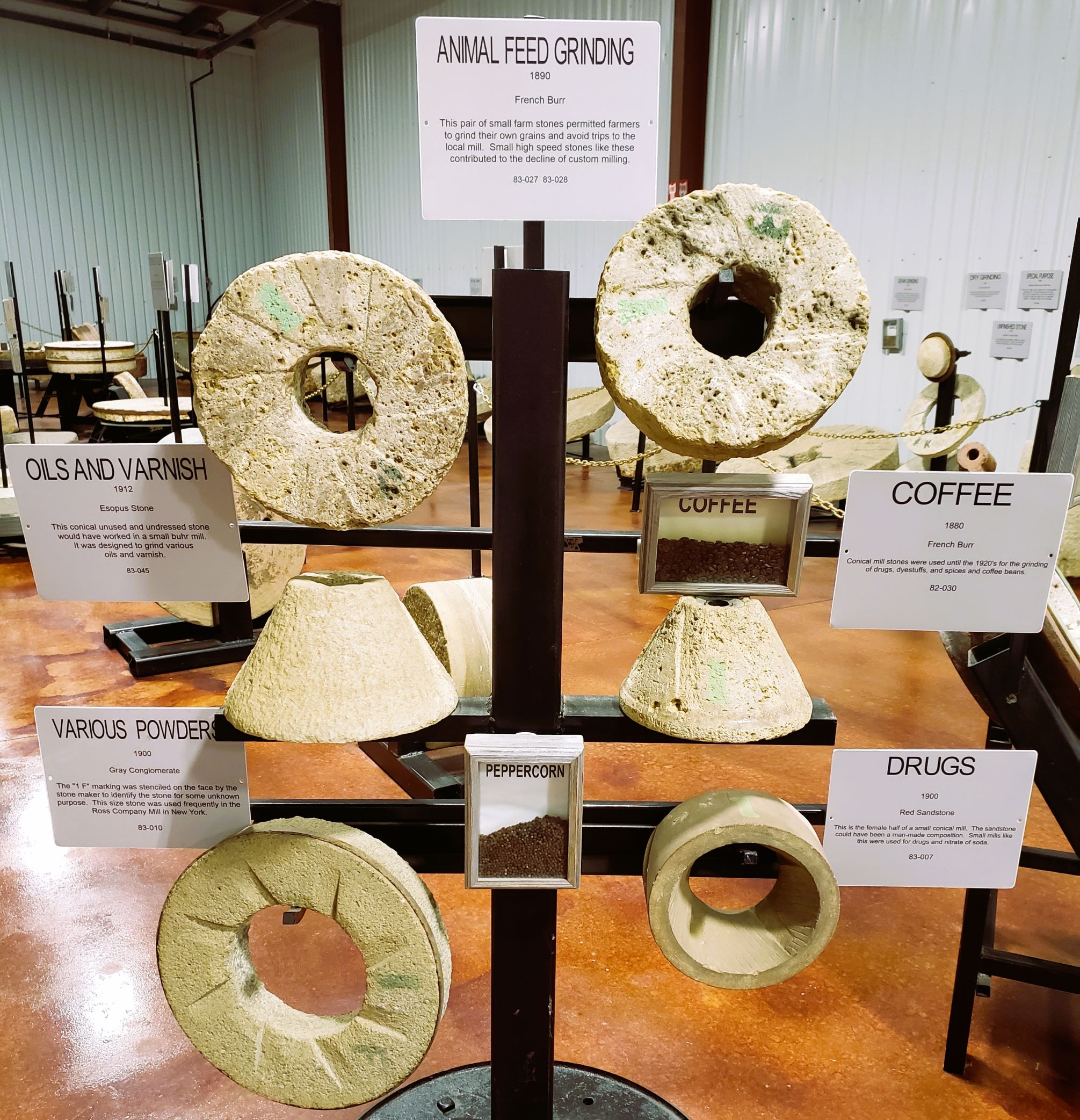
First, he oriented me to the different exhibits: G-scale (garden-scale) model train layout throughout the first building, the different types of windmills produced by many different companies, where to find the mill stones in the museum and where the mill stones came from, miniature houses, and another connected building with lots more windmills, as well as bird nests made from wire. I was feeling a bit overwhelmed.
Then he explained some of the unique wind turbines in the hall in which we were standing. There were four we discussed. The first two wind turbines (Japan and China) are very flimsy. They do not hold up well in Texas and Midwest winds.
1. The Zephyr from Tokyo, Japan (2011)
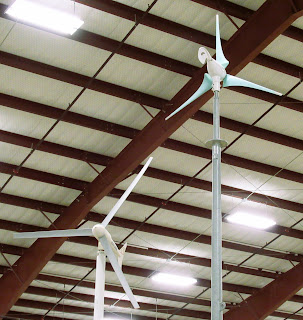 |
The Zephyr from Tokyo, Japan is the
light green wind turbine above.
WinPower from Ningbo, China is white. |
2. WinPower, Ningbo, China (2011)
Contrast #1 and #2 above with #3, the wind turbine created by Coy Harris's company, Wind Engineering Company in Lubbock, Texas. You can see how much bigger and more sturdy it is. It can hold up in our windspeeds.
3. WinGEN 28kw Wind Turbine. Coy Harris, who owned WinGEN, is now the Executive Director of the American Windmill Museum. The driving force to start up this museum was Billie Wolfe, a professor of home economics at Texas Tech in Lubbock who had a passion for windmills. She worked with Coy Harris to expand the collection of the museum. After Wolfe's death, Harris secured this 28-acre site and raised funds to pay for the initial collection and erect two large exhibit buildings.
 |
WinGEN 28kw wind turbine
from Lubbock, Texas. |
This turbine was restored by Coy F. Harris, and John Baker, the Chief Engineer for Wind Engineering Corporation. The controls on this exhibit were designed and built by Lubbock Electric Company.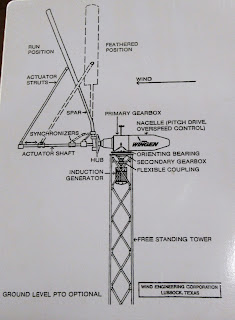 |
| The design of WinGEN. |
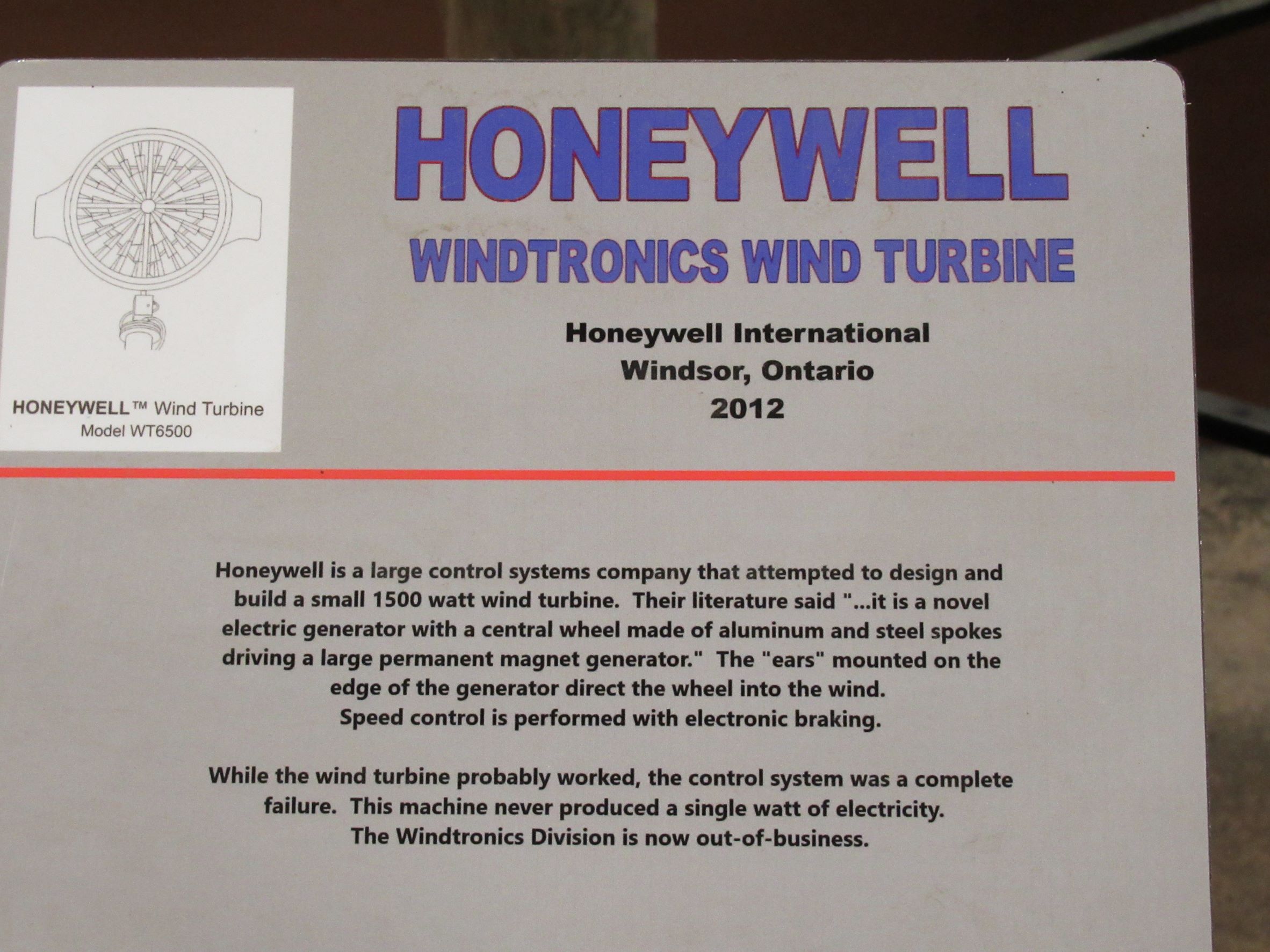
4. There was one last wind turbine in that exhibit and it looked completely different. I asked the docent about it. Apparently, the Honeywell Windtronics wind turbine was a dud. "This machine never produced a single watt of electricity."
 |
Honeywell Windtronics
Wind Turbine, Windsor,
Ontario. (2012) |
I finished chatting with the docent and started down the row of windmills by manufacturer. I'll post a few so you can see what you will find when you visit here, or at least know what you might be missing.
- Sunflower Windmill, Sunflower Windmill Company, Topeka, Kansas. (1890)
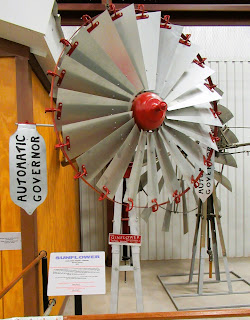 |
| The Sunflower Windmill. |
- Dempster #10, Dempster Mill Manufacturing Company, Beatrice, Nebraska. (Manufactured between 1914 and 1925).
 |
| Dempster #10. |
- Australian windmills - see photos below bulleted list.
- Metters
- Baby
- Ding Dong
- Early Ding Dong
- Alston 33
 |
| Metters, Baby (Australia). |
 |
Ding Dong and early Ding Dong
(Australia). |
You get the idea.
What windmills do: I knew that windmills pumped water for different purposes and also ground grain. New knowledge was imparted when I found out that some windmills (called wind chargers) early on were also used to charge batteries and generate electricity. During World War II, some ingenious soldiers on the Pacific Islands in WW II created a marine wind washer in 1944 from scraps found on the island to make a washing machine!
 |
Pacific Island windmill
washing machines
during WW II. |
 |
| I was blown away by this! |
While Bob was still on his phone call, I watched a video that showed how a huge wind turbine is shipped and installed on a wind farm. The wind turbines are immense. You have probably seen them being transported at odd hours of the day on secondary roads or freeways. You can't miss them!
Bob finished his phone call and we each explored on our own for about a half-hour more in the main building. Windmills were not the only subject. I will fill you in on more of the surprising exhibits in this building and the second building in Part 2 for today.
To be continued...