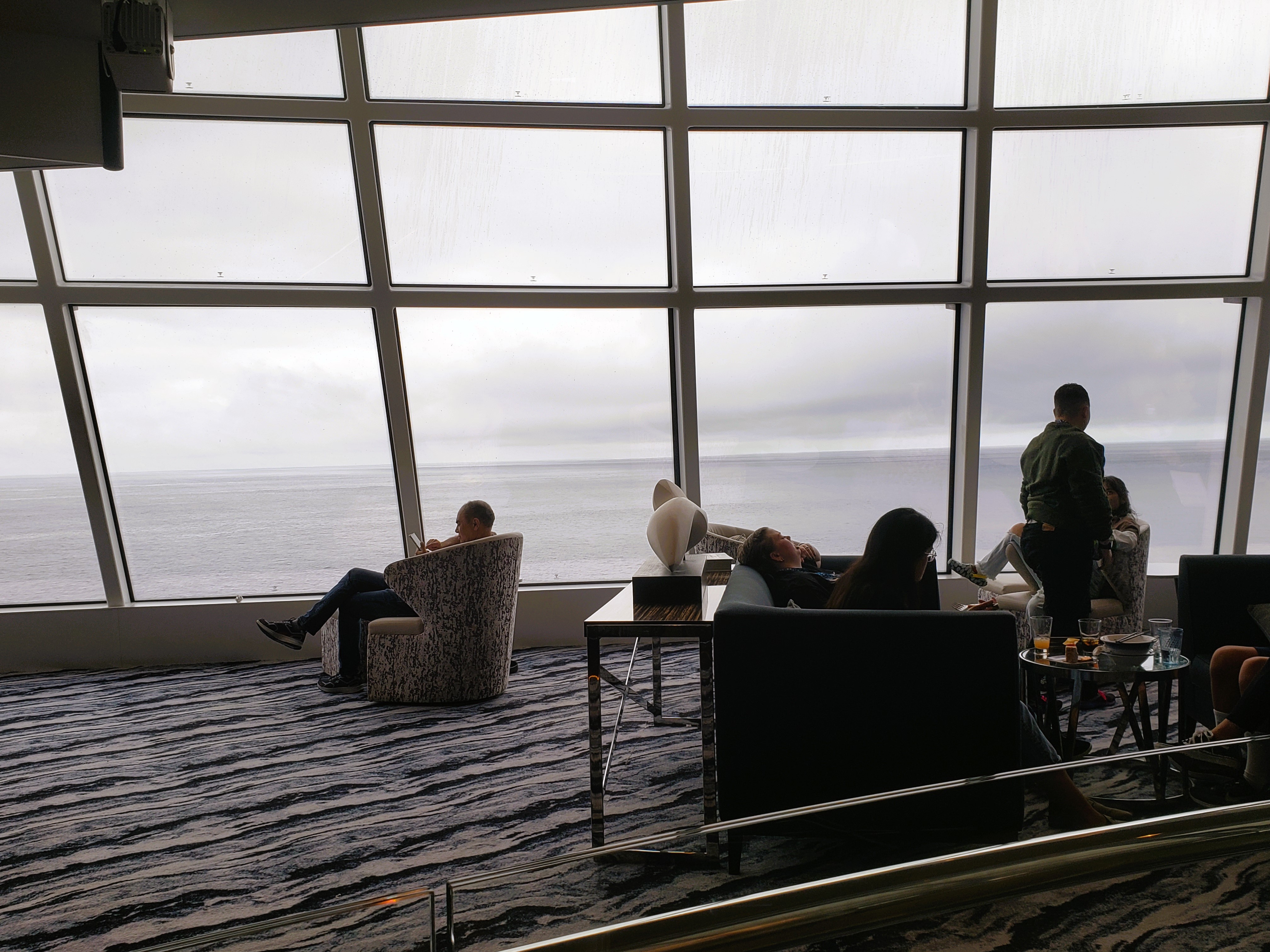
Day 3 on the Norwegian Bliss
Port: Sitka
Arrival: 11:00 a.m.
Plan for the day:
Susan will do two 5 km Volksmarches: one of the Russian Settlement including downtown Sitka with Susan and Darren Medlin; and the other one of the marina and Sitka National Historical Park by myself.
Bob walked with his mom, Liz, and Randy to the marina and Sitka National Historical Park to see the totem poles closest to the Visitor Center.
All aboard: 5:30 p.m.
Today's forecast: Cloudy with a high of 57° F.
Mid-morning, we sailed into Sitka Sound. The area is lush with coniferous trees.
Once known as "The Paris of the Pacific," Sitka is the first and oldest city in Alaska, having been settled by local indigenous Alaska natives more than 10,000 years ago. "The Paris of the Pacific" moniker came about because of the luxurious fur of the sea otters and the high price associated with those furs. The rapid growth of the sea otter trade and the fortunes it generated in the 1800s earned Sitka that title.
 |
| Sitka Sound as seen from our stateroom balcony. |
 |
| Sitka Sound as seen from our stateroom balcony. |
 |
| Kayakers in Sitka Sound. |
The following historical excerpts are taken from the National Park Services Department of the Interior 1989 brochure titled "Sitka Official Map and Guide."
In 1741 Danish navigator Vitus Bering, in the service of the Russian crown, made a discovery that sent Siberian hunter-traders sailing far across the North Pacific. His spectacular find was the Alaskan coast. Not until 1779 did the rest of Europe find out just how valuable the land's resources were. The survivor's of Captain James Cook's last voyage put in at Canton with a few hundred sea otter furs obtained in trade from Northwest Coast Indians.
The wealthy Chinese, accustomed to dealing with Russian traders who knew the value of the luxurious pelts, offered a price that astounded the British sailors. Word spread quickly, precipitating a flood of commercial ships to Alaskan waters. All along, the Russians had been hard at work building a wilderness empire that extended from the Aleutian Islands to Fort Ross, an outpost north of San Francisco. Sitka became the Russian colony's capital in 1808, and for a time thereafter was the busiest port in the eastern North Pacific.
That southeastern Alaska abounded with valuable resources was hardly news to the Tlingit people, natives of the panhandle's mountainous, densely forested islands. Sitka's Tlingit clan had inhabited their island for centuries. Seafarers by natures, they established a village called Shee Atika - meaning "people on the outside of Shee" (Baranof Island) - facing the calm waters of Sitka Sound. The ocean teemed with fish, the staple food; cedar and hemlock forests provided material for clothing, houses, canoes, and weapons. When the Russians challenged their claim to the land and water they called their own, the Tlingit retaliated with force. Their fierce determination failed in the long run to halt the Europeans. Eventually the Tlingits, Russians, and Aleuts, whom the Russians brought south to exploit their hunting skill, settled into a peaceful, though uneasy, life at Sitka. Together, they endured an inhospitable climate...Hunting, fishing, shipbuilding, and trading fueled native and European economies alike."The Russians, in their expansion of the West Coast of North America, settled in Sitka in the early 1800s and made Sitka the Capital of Russian America. There are still sites of the early Russian period of Sitka's history: St. Michael the Archangel Russian Orthodox Cathedral (AKA St. Michael's Cathedral) and the Russian Bishop's House in the middle of town. Sitka was the site of the signing of the Alaska Purchase on October 18, 1867. I'll talk about this more when I get to our two Volksmarches.
Today, the City and Borough of Sitka encompasses 4,710 square miles, making it the largest city in the United States. It is accessible only by plane or ship.
Once the ship docked, we walked to a complimentary shuttle bus to take us 15 minutes into downtown Sitka. Our Volksmarches started at the Harrigan Centennial Hall where the shuttle bus dropped us off.
The first 5 km walk Susan & Darren Medlin, and I did was to the Russian Settlement including downtown Sitka. This walk went past the marina, through the downtown shopping area, and past St. Michael the Archangel Russian Orthodox Cathedral (AKA St. Michael's Cathedral or the Russian Cathedral).
 |
| Sitka's Marina. |
As we walked along the marina, welcome signs informed us about sights to see in town.


 |
| In 1895, this was the Hanlon-Osbakken House. Now, it is the Sitka Rose Gallery. |
Within two blocks, we passed the Russian Cathedral. The italicized information below is from the National Park Service:
The St. Michael Cathedral is an outstanding example of Russian Orthodox architecture. Constructed between 1844 and 1848, this cathedral is the principal representative of Russian cultural influence in the 19th century in North America. From 1840 to 1872, Sitka was the Seat of the Russian Orthodox Diocese which governed all of North America, and thereafter it continued as the Seat of the Diocese of Alaska.
The original cathedral was built of native logs with clapboard siding. The roofs with the exception of the domes which were metal, were of wood shingles and later replaced with asphalt shingles. The architect was the first Orthodox Bishop of Alaska, Innocent Ioann Veniaminov.
The present cathedral is a reconstruction of the original building which burned to the ground in 1966.
After the cathedral burned in 1966, the object of the reconstruction was to create a reproduction of the original structure using modern, fire-resistant materials.
The Cathedral is constructed in the form of a Greek cross with a belltower, with the exterior elevations expressing interior spaces. The origin of this concept in Alaska can be seen in drawings of another church designed by Bishop Innocent, the Church of the Holy Ascension, built at Unalaska in the Aleutian Islands in 1825.
 |
| St. Michael's Cathedral in downtown Sitka, Alaska. |
Below are photos of the downtown shopping area.


 |
| One of several Sitka informational boards. |
 |
| Susan Medlin and I with "beary" big smiles. |
 |
| Crocosomia Red Swordflower "Lucifer." |
 |
| Blue eryngo. |
Next, we walked through a historic Russian Cemetery, followed by a stroll along part of the maritime port to a Russian blockhouse.
 |
| Historic Russian cemetery. |
 |
| Historic Russian cemetery. |
The next few photos are from the port area. This was the industrial, working part of Sitka.
 |
| A mural in the port area where seafood canning is done. |

 |
| An eclectic, rustic restaurant. |
 |
| Historic photo of the terrific fishing found in Sitka. |
The historic portion of Sitka continued with a walk-by of Sitka's Pioneer Home and "The Prospector" statue in front of it. There is a museum inside, but we didn't take the time to visit it. In 1913, Sitka's Pioneer Home became a refuge for aging "sourdoughs," or gold prospectors. The present structure, dating from 1934, houses more than 100 residents.

 |
| The Pioneer Home in Sitka, Alaska. |
 |
| "The Prospector," by Alonzo Victor Lewis. |
 |
| A plaque regarding the statue. |
From here, we continued up the hill to one of the three blockhouses that originally formed a wall to protect the Russians from the Tlingits. Tall, sharpened poles created a fence between the three blockhouses.


 |
| Susan and Darren Medlin in front of the second reproduction (1962) of a blockhouse. |

More history at this site tells of bridging the cultural divide between the natives and the Russians. Yakov (Jacob) Netsvetov became the first Russian Orthodox priest of Alaskan Native heritage in 1828. Father Yakov Netsvetov's life of sacrifice and service is typical of the "creoles" of Russian America. Creoles, the children of mixed Russian and Native households, were rapidly integrated into the everyday life of Russia's distant outpost.

 |
| St. Yakov's grave and the surrounding burial ground. |
 |
| Mountain views from St. Yakov's gravesite. |
 |
| We are going back through downtown Sitka. |

Our final piece of history in Sitka is Castle Hill (the Baranof Castle State Historic Site) where Russia sold Alaska to the United States in October of 1867, along with multiple other historic events. You can go to the top of the hill via the stairs or a long ramp.
 |
| Darren Medlin is part way up the stairs to Castle Hill. |
This hill is among Alaska's most important landmarks. Three eras of Alaska's history are represented by the people - Tlingits, Russians, and Americans - who claimed and occupied the hill. The hill's location and the fact that it was practically an island at high tides, made it a highly defensible site valued by three different nations.
- Noow Tlien: The Tlingit once controlled most of Southeast Alaska. This hill, known as Noow Tlien, was strategically located in their territory - a lookout point for defending their home and resources. It is thought that the Tlingit built four important clan houses atop it
- Novoarkhangel'sk: In 1799, fur traders, led by Alexander Baranov, established a fort on Tlingit land at nearby Gajaa Heen, now Old Sitka State Historical Park. The Tlingit destroyed the Russian fort two years later. Baranov returned in 1804 and, after six days of fighting at the Indian River, he claimed Noow Tlien for Russia: he called it Novoarkhangel'sk (New Archangel). Soon, the new redoubt included living quarters, fortifications, and cannons.
- Castle Hill: After decades of rule, Russia sold Alaska to the United States. On October 18, 1867, a transfer ceremony took place at this site and here the American flag was raised over Alaska. Ninety-two years later, Alaska became the 49th state of the Union and, over this hill, the first American flag with 49 stars flew.
 |
| Castle Hill. |

 |
| There are stunning views from Castle Hill. |
 |
| Ladies of the Hill. |
 |
| Men of the Hill. |
 |
| A small lighthouse is visible on the island. |
 |
| A replica cannon. |
 |
| The O'Connell Bridge in Sitka, Alaska. |
Volksmarchers love to go out to eat after a walk. Susan, Darren, and I were hungry! When we were on the bridge headed back to downtown, we saw a building with a "Mean Queen" sign on it. We wondered if it might be a restaurant. In the second-floor windows, we could see tables with people seated at them. Turns out, Mean Queen is a very popular pizza parlor. Three very happy people went upstairs for lunch.
 |
| The maritime port in Sitka as seen from the O'Connell Bridge. |
 |
| Sitka is nestled between the mountains and Sitka Sound. |
 |
| At the Mean Queen, we ordered our waiter's favorite pizza, Black Knight. It was great. |
 |
| Susan and Darren at our table in Mean Queen. And, yes, we DID finish that pizza!!! |
Our walk concluded at Harrigan Centennial Hall. We liked the canoe and small totem pole in front of the hall.
 |
| "Family Story Totem," by Preston Singletary. |
 |
| Tlingit Ceremonial Canoe. |
 |
| Information about the Tlingit Ceremonial Canoe. |