Cliff jumper, South Point, Na'alehu, Big Island - Monday, March 10, 2025

Cliff jumper, South Point, Na'alehu, Big Island - Monday, March 10, 2025

Tuesday, August 8, 2023

Alaskan Cruise, Day 4 - Juneau and the Mendenhall Glacier - Tuesday, August 8, 2023

Day 4 on the Norwegian Bliss

Port: Juneau
Arrival: 7:00 a.m.
Plan for the day: 
Bob, Louise, Susan, Laura, and Randall: Took a tour to the Mendenhall Glacier and the fish hatchery.
Susan and Darren Medlin: Walked the 5 km Juneau Capital Volksmarch.
Liz and Michael stayed on the ship. 
Kristin and Rich took a tour to see wildlife.

All aboard: 1:00 p.m.

Weather forecast: Cloudy with a high of 57° F.

Today's highlights for the afternoon: Endicott Arm scenic cruising and Dawes Glacier viewing.

This morning, those of us on tours were off the ship about 7:30 a.m. Laura and Louise ended up on a different tour bus from Bob, Randall, and me. We still met up at Mendenhall Glacier.

A beautiful morning for a two-mile roundtrip
hike to Nugget Falls.

At the Glacier, Bob spent time going to the Mendenhall Glacier viewpoint with Laura and his mom. I started hiking to Nugget Falls. 

When Bob, Laura, and Louise were done at the viewpoint, Louise and Laura took the elevator up to the National Park Visitor Center to shop. Bob raced along the trail to catch up with me. I made it to the falls, as did Randall, and Bob caught up just as Randall and I started back. Bob and I made a U-turn and went back to the falls for photos and to share the moment together with 50 of our unknown compatriots.

A memorial to Romeo, Juneau's friendly black wolf.

Nugget Falls is roaring from all the recent rain!

Nugget Falls is 377' in height.

Icebergs in Mendenhall Lake from Mendenhall Glacier.

Our attempt at a selfie. Ha. Ha.

Bob and I walked back to the viewpoint so I could capture photos from there. Along the trail, I found a pretty wildflower in bloom. 

Dwarf Fireweed (Chamerion latifolium).

Mendenhall Glacier is one of Juneau Icefield's 38 major glaciers. It flows from the southern half of the large icefield. Mendenhall Glacier is a Little Ice Age relic from approximately 3,000 years ago and is a retreating glacier. 

Mendenhall Glacier and Nugget Falls fast facts:

  • Length of Mendenhall Glacier: Approximately 13.6 miles.
  • Distance from downtown Juneau: 12 miles.
  • The glacier and surrounding landscape are protected as part of the 5,815-acre Mendenhall Glacier Recreation Area, a federally designated unit of the Tongass National Forest.
  • The glacier has retreated 1.75 miles since 1929, when Mendenhall Lake was created, and over 2.5 miles since 1500.
  • The Juneau Icefield is the fifth largest in North America.
  • It was originally known as Sintaantaago ("the Glacier Behind the Town") or Aak'wtaaksit (the "Glacier Behind the Little Lake"). The glacier was named Auke (Auk) Glacier by naturalist John Muir for the Tlingit Auk K'waan band in 1879. In 1891, it was renamed in honor of Thomas Corwin Mendenhall. 
  • Thomas Corwin Mendenhall served as Superintendent of the U.S. Coast and Geodetic Survey from 1889-1894, and on the Alaska Boundary Commission that surveyed the international boundary between Canada and Alaska.
  • Nugget Falls is fed by Nugget Glacier. It is 377' tall.
  • Romeo the Wolf: Romeo was a wolf who lived around the Mendenhall Glacier from 2003-2009. He was killed by out-of-state poachers. The Visitor Center has an exhibit and taxidermy of Romeo's pelt to commemorate him and the town's love for him. Romeo is brought to life in Nick Jan's book, "A Wolf Called Romeo."
  • Why is the ice blue? Glacial ice appears blue because it absorbs all colors of the visible light spectrum except blue, which it transmits. The transmission of this blue wavelength gives glacial ice its blue appearance. Glacial ice may also appear white because some ice is highly fractured with air pockets and indiscriminately scatters the visible light spectrum.


The Mendenhall Glacier comes all the way down to
the water which makes it a tidewater glacier.

Iceberg in Mendenhall Lake.

I zipped up to the Visitor Center to do a quick look at the gift shop. I thought I had 20 minutes before we had to catch the tour bus, but when I looked at my watch I thought I was late. I raced down the stairs to the tour bus stop and the bus wasn't there. One more look at my watch revealed I was ten minutes early. Oops.

Our next stop on the tour was at Macaulay Salmon Hatchery. Our tour bus driver drove past the hatchery. We had to drive a few miles before she could turn around to take us back. 

We had 25 minutes to look at all the exhibits and watch salmon going up the salmon ladder. A large indoor room was dedicated to raising salmon. The exhibits educated us on the life cycle of salmon.

The salmon were making their way up this 
fish ladder.

The next few photos have the life cycle of the salmon from the egg to their release into the ocean and their migration.


The next stop for me was the touch tank. It was pretty small, so I only spent a little bit of time there.

From there, I made my way to the saltwater aquarium. There were lots of interesting fish in there, but I thought the moray eel was pretty cool.

A huge crab!

Scary-looking Moray eel.

Outside exhibits at the fish hatchery included a viewing platform where we could watch salmon returning to the hatchery (and the seals taking their meals from the easy pickings).

The totem pole exhibit was good. It identified the different creatures on the poles.


The wonderful sculpture of the "Gang of Four" bears photo sadly lacked some of the bears. The sun was so bright on my cell phone screen I couldn't see what I had in the viewfinder. As you will see in the photo, I only took a picture of the two cubs. Sigh.


Randall waiting to get back on the bus.

It was time to return to the ship. We made it on time and soon we were heading to the Endicott Arm fjord and the Dawes Glacier.

When we left, there were four more cruise
ships in port at Juneau.
This huge waterfall was on our 
way to Endicott Arm.

We were cruising in Stephens Passage and were supposed to turn into Endicott Arm fjord this afternoon. A tour had left earlier in a smaller ship for those who wanted a closer, more personal experience of the Dawes Glacier. 

As we entered Endicott Arm, fog engulfed the surrounding mountains. The small tour boat radioed that Dawes Glacier was fogged in and they couldn't see anything. They were bringing the tour group back to the ship. We waited quite a while for them to return and reboard the ship. Unfortunately, we did not get to see Endicott Arm fjord or the Dawes Glacier. 

Our ship headed for our next destination, Icy Point Strait. We had dinner and then went to see "The Beatles Experience: Beatlemania" in The Cavern Club at 8:00 p.m. As usual, we had a great time singing along to Beatles hits.

That's all folks. 

Monday, August 7, 2023

Alaskan Cruise, Day 3, The Sitka National Historical Park - Part 2, Monday, August 7, 2023

Continued from Part 1...

I said goodbye to Susan and Darren who headed back to the ship to rest. Now, I'm going to do the second 5 km on my own. This is the part of Sitka I'm most interested in seeing: Sitka National Historical Park with its totem forest.

The first part of this 5 km walk started by following the sidewalk along the marina. I detoured across the street to look at the Russian Bishop's House, a totem pole in front of a school, and St. Peter's By the Sea Episcopal Church. 

While I was taking photos of the Russian Bishop's House, who should show up but Bob? He was walking along the marina with his mom when he saw me. We had a smooch and took a selfie. 

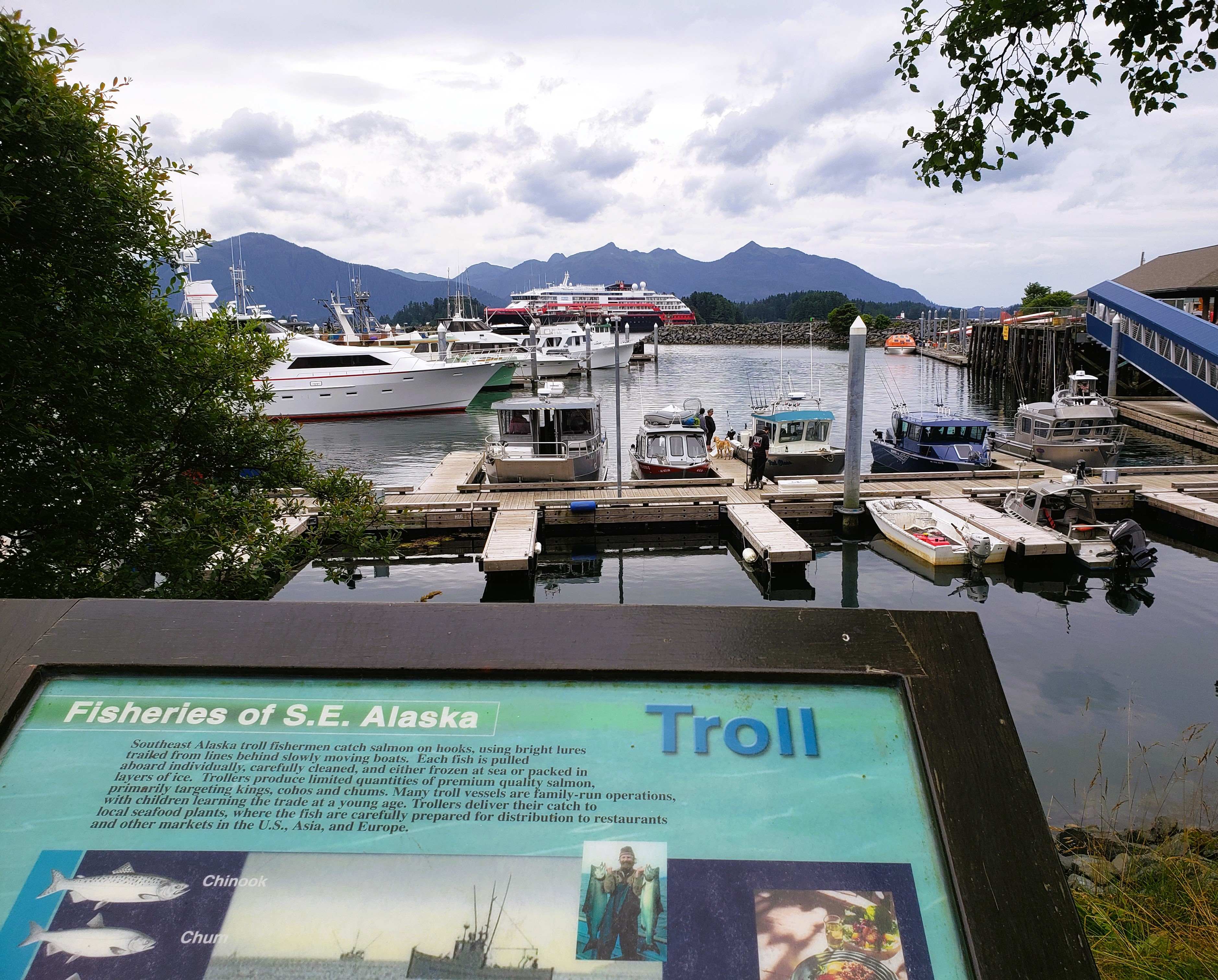
All along the marina are signs explaining the
different types of ocean fishing. 

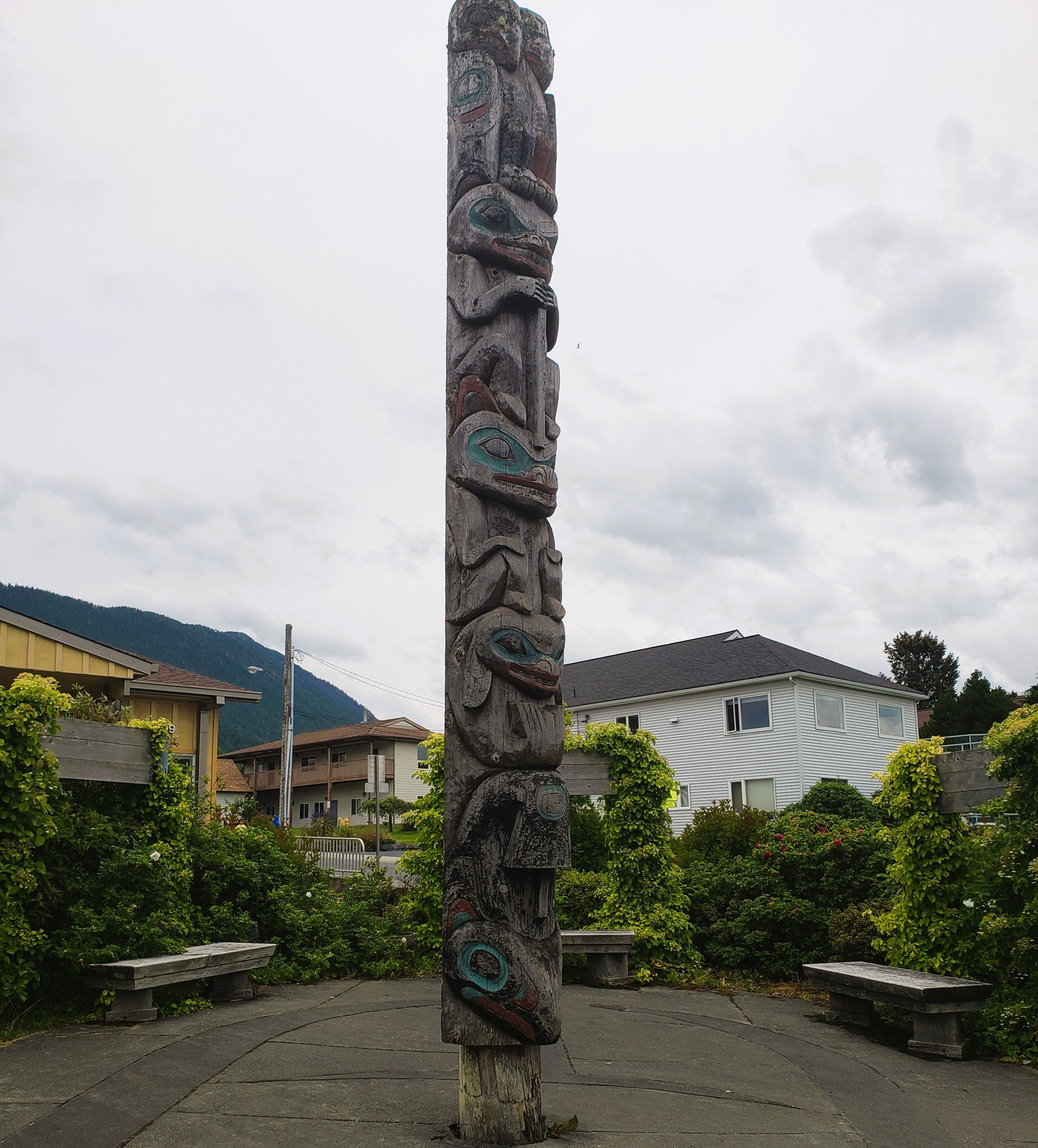
A totem pole in front of the school.

The history of the Russian Bishop's House is one that has been repeated over and over in the indoctrination of Native peoples into white cultures. 

The history of the Russian Bishop's House.

The Russian Bishop's House.

After I obtained a national park stamp in my national park book for the Russian Bishop's House, I walked over to say hi to Louise. She's doing very well walking with her oxygen compressor. Bob, Liz, Kristin, and Laura all help her get around both off and on the ship.

St. Peter's By the Sea Episcopal Church.

St. Peter's By the Sea Episcopal Church.

I returned to walk along the marina and learned from the signboards that besides trolling, other types of ocean fishing are gill-netting and longline fishing. 

Sitka, Alaska, marina.

Multiple other signs provided by the Sitka Sound Science Center help educate about the "Value of Seafood," "Salmon Neighborhoods: Eat or Be Eaten,"  "Salmon Need the Rainforest," "Plants of the River Edge," "The Tongass Rainforest Needs Salmon," and "The Sitka Sawmill Rehabilitation."


Along the coastline, families were out enjoying
the day. You can see a cruise ship out in the bay.
(That is not our ship.)

When I made my way into the Sitka National Historical Park, I found more indoctrination, evangelism, cultivation, and edification of the Native people took place when the Americans bought Alaska. The Tlingits gave up their way of life, culture, and language to live in the "cottages" that the Americans provided. 


What I really want to see is the Totem Trail. For more than a century, the Totem Trail has been a Sitka landmark. None of the poles came from Sitka. 

Alaska Governor John Brady collected the totem poles here from villages in southeast Alaska. Brady was friends with the Alaskan Natives. They honored his friendship by donating their totem poles. In return, Brady promised to preserve the poles and persuade the U.S. government to provide schools and aid to their villages.

Brady viewed the poles as curiosities from a culture soon to be lost to "modern" ways. He collected them to exhibit at two world fairs (1904-1905), one was the Louisiana Purchase Exhibition in 1904. 

After the fairs closed, Brady shipped the poles to Sitka. Here, in what was the original capital of the Alaska district, the poles were preserved in a "government park" in honor of their donors.

A local photographer, Elbridge W. Merrill arranged the totem poles along a trail in 1906 and donated money to preserve and repair them. He became the first custodian of the Sitka National Monument in 1918 for a salary of $12 a year. Local photographers made postcards of this part of the Totem Trail, nicknamed "Lover's Lane," to encourage tourists to travel to Sitka.

Let's take a look at these wonderful totems.

The National Park Visitor Center.

I made sure to collect my national park stamp in my National Park Book while I was here. Unfortunately, we were not in Sitka long enough to do two walks AND visit all the museums. Hopefully, we can return one day to explore the history more.

Another totem by the visitor center.

This totem is by the beach in front
of the visitor center.

This grouping of three totems is up the hill
from the visitor center. The 5 km walk took me
up this little hill and back down.

A colorful totem pole behind the 
visitor center.

At this point, I entered the Totem Trail in the forest. It was raining slightly and the farther I got from the visitor center, the fewer people there were. 

The photo below is the Yaadaas Crest Corner pole. The Yaadaas Crest corner poles originally stood at each corner of the Yaadaas clan house in Old Kasaan and represent the symbols of that clan. Steve Brown and Tlingit carver Nathan Jackson carved this replica in 1982.

Yaadaas Crest corner pole.


The meaning of the Raven Shark pole in the photo below: The Raven Shark pole is a legend pole. While it may represent the clan symbols of the Tlingit patron's wife, it may also symbolize the raven/shark legend. Tlingit artist Tommie Jimmie carved this replica pole in 1978.

The Raven Shark pole.

The Trader Legend pole (pictured below) is a ridicule pole. At the top is a white man and below are images representing thievery. This pole is a replica carved between 1938 and 1942. Although the original story associated with this pole has been forgotten, when the pole was recarved the images became associated with a dishonest Sitka trader. This pole lives on with a new story.

Trader Legend pole.


Bear warning signs were posted in the forest, so I was hypervigilant and made noise to warn any bears lurking in the trees to stay away from me. The bears were interested in the salmon returning to spawn in the creek here. I made it through safely.

Stunning view of the mountains surrounding Sitka!

The Alaska rainforest. I'm looking for bears.

Salmon returning to spawn; it is
likely bears will be nearby to dine.

While I headed out of the forest for the last leg of the walk, Bob called. He wanted to meet up and finish the walk with me. I told him where I was and he was there in ten minutes. We walked by the Sitka National Cemetery and then back along the marina to the start/finish point of the walk. We boarded a shuttle bus there to go back to the ship (seven miles north).

Sitka National Cemetery.

Returning to the Norwegian Bliss in Sitka.

Cold, wet travelers (us) ready to board the ship.

Sitka is a wonderful port and one we hadn't been to before. I am so happy that there are Volksmarches here. It's a great way to see a new place and get exercise as well. 

Thank you to the Central Washington Sun Striders Club for creating walks to the major sites in Sitka. Sitka is only accessible by boat and plane so we want to let you know that your foresight in setting up these walks for cruise ship and plane travelers (and possibly locals) is wonderful. We appreciate your efforts!!!

For entertainment this evening, we saw "SIX: the Musical." I enjoyed the singing and dancing; it reminded me of the movie "Chicago" (2002) with Renée Zellweger, Catherine Zeta-Jones, Richard Gere, John C. Reilly, Queen Latifah, and Taye Diggs. 

Tomorrow, we will be in Alaska's state capital, Juneau.