Cliff jumper, South Point, Na'alehu, Big Island - Monday, March 10, 2025

Cliff jumper, South Point, Na'alehu, Big Island - Monday, March 10, 2025
Showing posts with label St. Augustine Florida. Show all posts

Monday, November 2, 2020

The Freedom Trail and A World-Class Destination, St. Augustine, Florida - Part 2, Monday, November 2, 2020

Continued from St. Augustine, Part 1...

When we exited through the Old City Alleyway, it was like stepping from old St. Augustine into a New World. The City Square impressed us with the multi-story Treasury on the Plaza, originally built as a bank in 1927. 

Treasury on the Plaza.

One of the first historical exhibits we saw was "The Freedom Trail." In 1955, St. Augustine's first downtown shopping center was built. It was designed by Morris Lapidus, Florida's most famous mid-twentieth century architect, and is the only example of his work in this ancient city. The shopping center was anchored by a Woolworth's store on the west side. The door handles still say Woolworth's!

Woolworth's door handles.

On February 1, 1960, black college students in Greensboro, North Carolina, began a sit-in at their Woolworth's lunch counter to protest racial discrimination. Just a few weeks later, students from Florida Memorial College in St. Augustine began sitting-in at this Woolworth's lunch counter. In the summer of 1963, local black high school students sat-in here and were arrested. The St. Augustine Four--Audrey Neil Edwards, JoeAnn Anderson, Samuel White, and Willie Carl--refused to end their participation in the civil rights movement. They spent their next six months in jail and reform school, and received national publicity as an example of injustice. The governor and cabinet of Florida ordered them released in January 1964. Dr. Martin Luther King, Jr., and Jackie Robinson hailed the St. Augustine Four as heroes of the civil rights movement. [Information obtained from a historical marker placed by Northrop Grumman in downtown St. Augustine.]

As we walked down the street, we went from the 1960s, back in time to the late 1880s. Three imposing, world-class structures came into view simultaneously: Casa Monica Resort, Flagler College, and Lightner Museum. Most of these buildings were made possible by Henry Flagler, co-founder of Standard Oil Company, and developer of the Florida East Coast Railway.

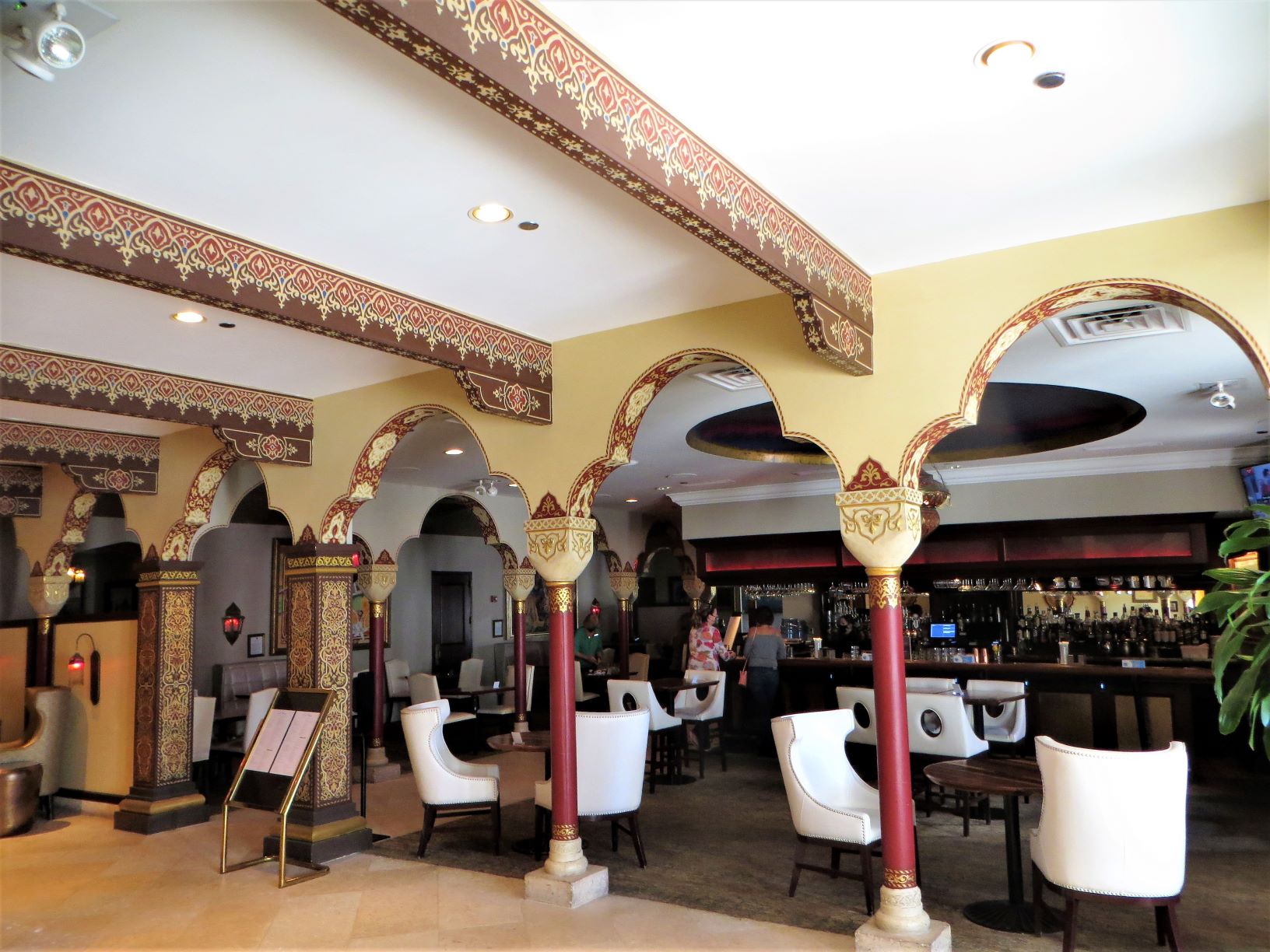
I'll talk about Casa Monica first, since it was the first of the three buildings we walked to. Our walk directions suggested we go inside to see the lobby and bar. We were so impressed, I looked up the history of this Grand Dame on historichotels.org. Here's the scoop:

Casa Monica Resort & Spa.

Henry Flagler sold the land to Franklin Smith as soon as he founded a spur to one of his local railways through St. Augustine. Franklin W. Smith, an architect, was a noted Civil War-Era abolitionist and social activist, who possessed a deep interest in Victorian architecture. He originally decided to build a magnificent building at the end of the 19th century due to the rise in Florida's tourism industry. The hotel debuted on New Year's Day in 1888, following a year of arduous construction work. Smith had a passionate fascination with Revivalist architectural forms, specifically Moorish Revival style. 

Casa Monica lobby.

Casa Monica lounge area off the lobby.

Casa Monica's car.

In just four months, Smith had put the hotel in serious financial trouble. Fearing he could not keep the business going, he reached out to Flagler for relief. The railroad magnate subsequently purchased the entire facility from Smith, including "all fixtures, furnishings, silver, hardware, linen, bedding, parlor, hall, dining room, and kitchen furnishings and all other chattels" for $325,000. Flagler renamed it the Cordova Hotel and it prospered under his ownership. Flagler was also one of the nation's top hoteliers. In fact, Flagler already owned two other destinations in St. Augustine--the Ponce de Leon Hotel (now Flagler College) and the Hotel Alcazar (currently the Lightner Museum).

We exited Casa Monica through the lobby door and were immediately in awe of the buildings across the street. Our next destination was the Lightner Museum building, formerly Hotel Alcazar. The Hotel Alcazar was originally owned, constructed, and opened as a luxury hotel by Henry Flagler in 1887-1889. The Alcazar was part of a trio of Moorish and Spanish Renaissance Revival-styled resorts that depicted Flagler's ideal of an "American Riviera" in St. Augustine. The hotel was constructed of cast concrete with coquina shell aggregate and terra cotta features.

The interior photos below are of the recently restored lobby/ballroom area which can be viewed free of charge. The Lightner Museum entrance is behind the ballroom. Unfortunately, we did not have time to explore the museum today.

Lightner Museum
(formerly Hotel Alcaraz).


Lightner Museum.
Lightner Museum tower with
terra cotta finishes and
statue of Pedro Menendez.
Interior courtyard koi pond.

Interior courtyard of Lightner Museum,
complete with Lightner's grave. 

Cassone (wedding chest) from Italy,
unsigned, circa 1880.


Restored lobby/ballroom.

Mid-19th century
Grandfather Clock.


The hotel closed in 1931 and was purchased by O.C. Lightner in 1947 to exhibit his collections. The building is now the Lightner Museum and City Hall.

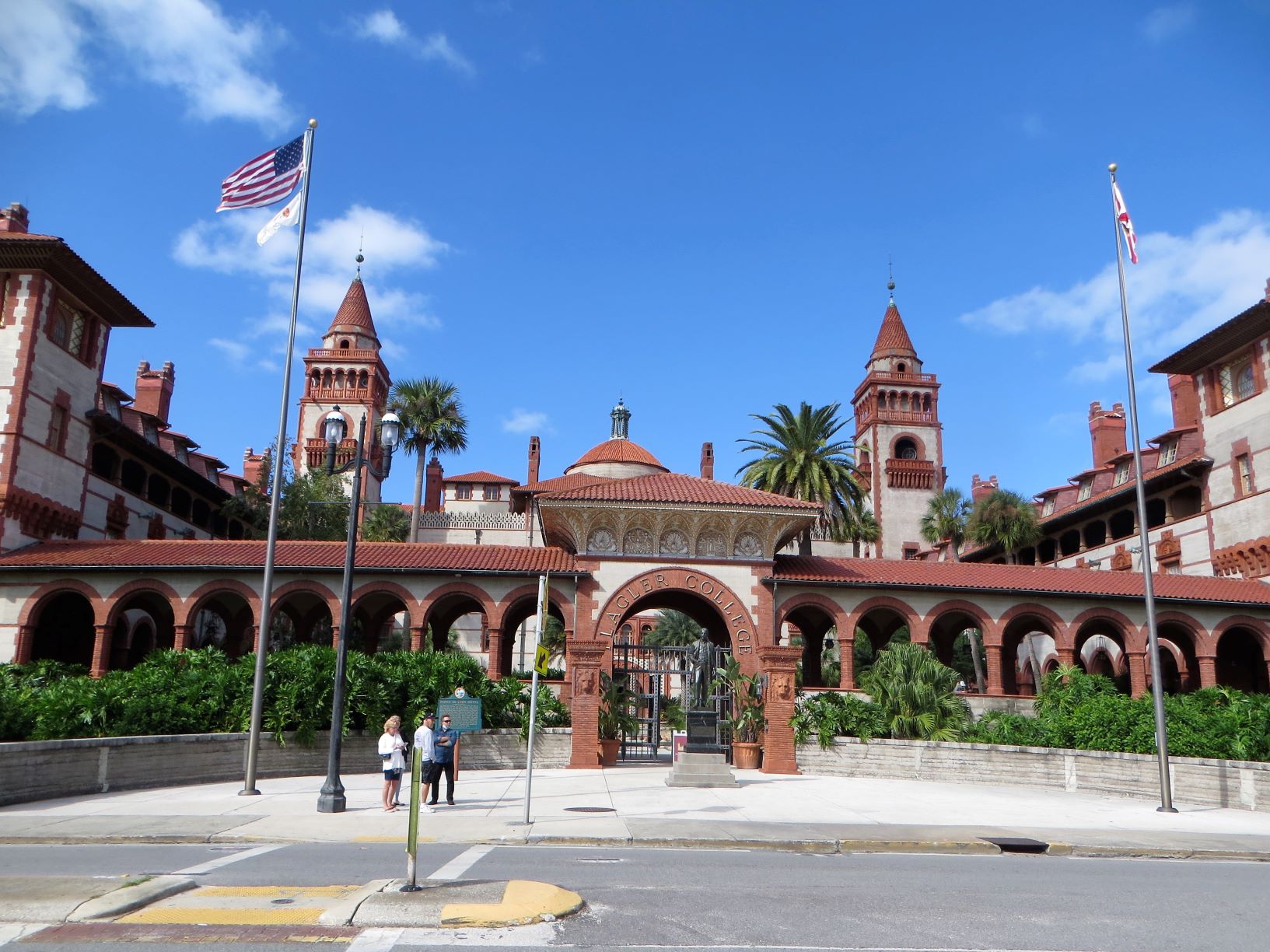
Next, we crossed Granada Street to Flagler College. Wow! This was originally Henry Flagler's Ponce de Leon Hotel, one of the most fabulous hotels in the world. My jaw dropped upon seeing the detail and grand design displayed on the outside. 

The inside is supposed to be extremely luxurious, including the windows in the dining hall which comprise the single largest private, currently in-use collection of Tiffany stained glass works in the world. Not too surprising since Louis C. Tiffany was hired to decorate the interior of the hotel. 

Unusual for the era, this hotel had electricity installed at the time it was built. Thomas Edison, Flagler's friend, did the installation. He used DC generators to power the electricity which caused the bulbs to explode from time to time as they were turned on.

Now for the name dropping...Frederick Vanderbilt and William R. Rockefeller attended the opening. Guests included Mark Twain, Babe Ruth, Robert Frost, John dos Passos, Somerset Maugham, Ernest Hemingway, and Presidents Grover Cleveland, William McKinney, Theodore Roosevelt, Warren Harding, and Lyndon Johnson.

During World War II, the hotel was taken over by the federal government and was used as a Coast Guard Training Center. St. Augustine is considered to be the birthplace of the Coast Guard Reserve. After the war ended, the building was deactivated by the Coast Guard and returned to operation as a hotel. 

Originally, the twin towers of the hotel were water storage tanks and contained 8,000 gallons of water each which provided running water to the guests. During World War II, one of the towers served as a brig for the U.S. Coast Guard Training Center.

We could not go in to see all the opulence contained within due to the COVID-19 virus. Only students are allowed in at this time. I hope they know how lucky they are!

Flagler College (formerly
Ponce de Leon Hotel).


Flagler College entrance.
Flagler College.

Flagler college - detail of a tower.

Flagler College entry gate.

Statue of Henry Flagler.

Looking through the college
gate into the courtyard.


Stairs going up to the building
to the right of the entrance.

If we are ever in St. Augustine, and Flagler College is again open for tours, I definitely want to go inside to see the grandeur.

This is all for Part 2 of the St. Augustine 10k Volksmarch. Part 3 to follow.


We Found the Fountain of Youth in St. Augustine, Florida, on the 10k Volksmarch - Part 1, Monday, November 2, 2020

On Sunday, we drove from Quincy, Florida, to Anastasia State Park in St. Augustine, Florida. The first landmark that caught our eye was the beautiful lighthouse. We will visit this later in the week. 

St. Augustine Lighthouse.

Anastasia State Park is pretty. The loop we were in had tight quarters. It was like a tropical jungle. During our back in into our site, we had a couple of small mishaps, nothing major. Our 5th wheel and pickup truck barely fit. 

Monday we explored St. Augustine on a 10k Volksmarch. It was wonderful! The 6.2 miles took us 4-1/2 hours. There's history galore, amazing architecture, and plenty of art. The only time we sat down all day was to have ice cream cones at Tedi's Olde Time Ice Cream on St. George Street based on a local's recommendation.

We began the walk by entering the grounds of The Shrine at Mission Nombre de Dios (Name of God) Sacred Acres and immediately passed by the Prince of Peace Catholic Church. 

Toward the back of the garden area is a 208' tall steel cross. This is said to be the site of the original landing of Don Pedro Menendez de Aviles and the first Mass was said in 1565. This was 55 years before the Pilgrims landed at Plymouth Rock! We also saw the original chapel built in 1615. It was the first Shrine ever to be dedicated to the Blessed Virgin Mary in the New World.


Gale force winds accompanied us today. We kept a tight grip on our walk instructions.

The grasses are leaning
sideways in the wind!


"America's most sacred acre."


This chapel is the fourth
building on this foundation.

From Mission Nombre de Dios, we walked to see the oldest living resident of the oldest city -- The Old Senator -- an oak tree estimated to be over 600 years old. It lives in the middle of the Villa 1565 motel.

"The Old Senator."

Upon exiting from Villa 1565, we were on Magnolia Ave. which is designated one of the Ten Most Scenic Streets in America. This is one place to see trees draped in Spanish moss.

Magnolia Ave.

It was on this street that we found Ponce de Leon's Fountain of Youth. You can go in an drink from the Fountain of Youth (admission fee).


Bob hangin' out with
Ponce de Leon.


What you get with your admission.

Pedro Menendez de Aviles
(1519-1574).

Tropical-style homes looked so inviting on our walk through one of St. Augustine's neighborhoods. Shortly, we came to the Old Jail and Florida Heritage Museum complex with its general store and history markers. The jail was built in 1890 and used until 1953. Unfortunately, we did not have time to take the jail tour. (Admission fee.)

This home looks very inviting.

A funny political sign.

The Old Jail Museum.


There was a staff person from the museum hanging out by the General Store who wanted us to pay for a museum tour. We read the signs they had out front and looked at their displays but just couldn't fit in a visit.

A manure spreader.


The General Store.


Exhibit about a cracker horse.
General Store at Old Town
(the Old Jail complex).

Another lovely neighborhood was on our route to Castillo de San Marcos. Most of these are historic homes. I enjoyed seeing the art and artistic detail. One home even has a "Chick-Inn" coop!


The birds have flown the coop.

Cute home with petty colors.

This home is huge!

My very favorite door, ever!
This is the home with the
stained-glass entry door.


The Chick-Inn coop!

How's this for a swanky chicken coop?

Art along the street.

Very pretty painting.


From this neighborhood, we walked onto the grounds of the Castillo de San Marcos National Monument. It is not open Monday through Wednesday, so we could not go inside.

Entering Castillo de San Marcos.
Castillo de San Marcos National Monument.

Below are some of the activities that used to be performed at the Castillo which was used as a fort during the Spanish occupation, the American Revolution, and the American Civil War.


This fort has a moat that was used for many different purposes. It no longer has water in it.
The moat.


Entry gate into the fort. 

The fort walls are made of coquina, a local limestone. Over the years, this porous material has eroded. The Spanish covered the coquina with plaster to help preserve it.


Bob and I enjoyed learning about the fort. This is not the history we learned growing up on the West Coast.

St. Augustine was built on the Matanzas River. Barrier islands protect the city from hurricanes. Now, we will walk alongside the river which is part of the Atlantic Intracoastal Waterway. 

As an aside, the wind was howling and the river had big whitecaps. The boats moored out in the river were rockin' and rollin'. Bob said the owners of the boats could go out today and go for a ride without even pulling up the anchor! 

Next, we came to the Bridge of Lions. The Bridge of Lions was built in 1927 so Anastasia Island could be accessed without a ferry ride. 

The malecon along
the Matanzas River.
Bridge of Lions.

Me and Bob at the Bridge of Lions.

History of the St. Augustine Boat Basin.

The Bridge of Lion's drawbridge opened
for a yacht to come through.


From the river, we headed to the St. Francis Barracks. In this area, General Worth, founder of Woolworth's, had a family home. It was originally built in 1790 by Don Miguel Ysnardy. It is now O. C. White's Seafood and Spirits. The street leading up to St. Francis Barracks is lined with Bed & Breakfasts. 

Bayfront Marin House Bed & Breakfast.

Westcott House Bed & Breakfast Inn.
St. Francis Barracks

Florida National Guard.

We walked through St. Augustine's
National Cemetery.


From the National Cemetery and St. Francis Barracks, we moved into the oldest homes in the city, some dating back to 1650. 
The oldest house in the city is the Gonzalez-Alverez home (circa 1630). The earliest homes were thatched wooden structures. However, in 1702 the British burned St. Augustine. The replacement homes were made with coquina stone and were originally a one-story structure with two rooms. With British and American occupation, additional stories, balconies, and other amenities were added.


Gonzalez-Alverez home,
St. Augustine's oldest house.


El Camino Real, the King's Road.


A row of historic homes.


Llambias House.

A few Halloween decorations were still out.


Halloween 2020: These people REALLY wanted to social distance with their candy chute.

Sisters of St. Joseph of St. Augustine.

The historic homes in this area
have cobblestone streets.

If you love history and historic homes, you must come to St. Augustine to see these. Many homes are museums now and can be toured. The walk criss-crosses many of these older neighborhoods. NOTE: Watch your footing carefully on the cobblestone streets and sidewalks with disrupted concrete! 

Art in a courtyard.
Spanish Military Hospital Museum.

You will exit King St. and the historic home section through the old City Archway to City Square -- the Old Market Place -- where the slave trade was very profitable at one time.

Aviles Street City Archway.


In order to make today's blog a shorter length, I am breaking it into parts. This is an excellent place to stop this section because where we go next is decidedly different from what we've seen so far. 

This will be continued in Part 2...