The weather took a turn for the worse today, but not horrible. The temperature was 82 yesterday, but nose-dived to 42-degrees F. today. Nothing a sweatshirt and warm coat couldn't handle. We also had off and on showers, more misty than pouring rain. Good hiking weather.
We headed east on U.S. 2 from our campground in Bessemer until we reached Wakefield where we stopped in a Visitor Center. We wanted to make sure we knew where we needed to go. Next to the Visitor Center is a beautiful wood carving, the 60th of Peter Toth's carvings in the "Trail of the Whispering Giants." The carving is called Nee Gaw Nee Gaw Bow. Even though the photo looks like we had pretty weather, I am here to tell you it was windy with blowing, misty rain. Brr.
In the background across the lake is Eddy Park Campground (Sunday Lake). It is a pretty campground in a great location, but the sites are unlevel and grassy. If you'd like to stay at this campground you may want to drive through first. There are no trees separating the sites which are pretty close together.
We turned north on State Route 519 to head for another group of waterfalls. (Yes, there are lots of waterfalls in this area...150 scattered across two counties.)
 |
| Rain and fall colors |
 |
| My lap while we're driving (got to navigate!) |
 |
| More colors |
We are headed into the Presque Isle River Scenic Area. Presque Isle is the largest river in the Porcupine Mountains (locally called "The Porkies"). During times of high water a peninsula, at the mouth of the river where it flows into Lake Superior, becomes an island. Hence, the early fur traders called it Presque Isle (French for "almost an island").
 |
| Nawadaha Falls |
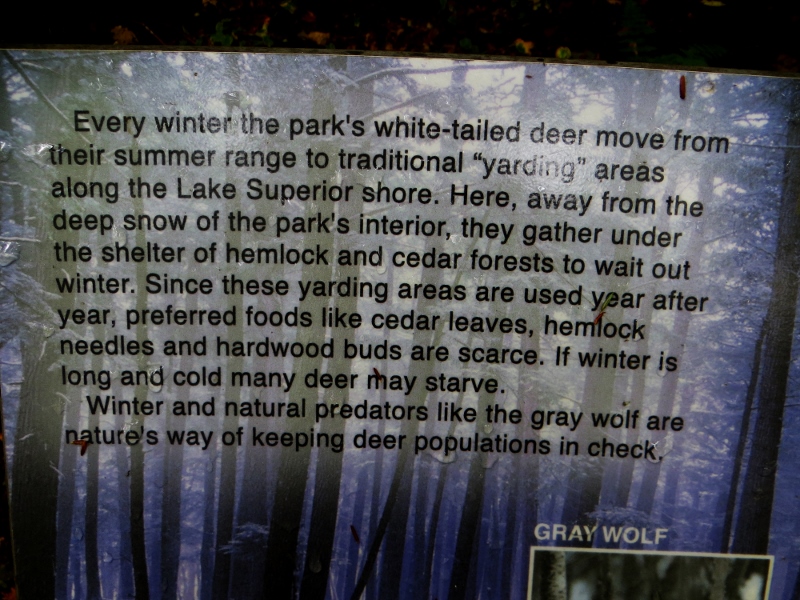
During the day yesterday Bob had asked if the deer migrate away from the Upper Peninsula during winter because of the cold. I told him I didn't know. Today we had our answer. The deer over-winter in these forests; it's called "yarding." See sign below for more info if you're interested.
From Nawadaha Falls, we drove to Manabezho Falls parking lot. We thought we'd see that waterfall then drive to the trailhead closest to Manido Falls for a shorter hike. Once you get going on the trails, boardwalks and stairs to Manabezho Falls you don't want to climb back up to go to another trailhead to climb back down again! We opted to stay on the lower boardwalk between falls, but even that had stairs.
At the beginning of the Manabezho Falls hike there is an option to go left to a suspension bridge then walk out to Lake Gitchee Gumee (Superior). After a left turn and some stairs, we came to the suspension bridge. From the bridge you can see the power of water as it carves potholes into the rock edges of the river.
 |
| Potholes being carved in the edges of the rock walls |
 |
| Very powerful water flow through here |
 |
| Suspension bridge to Presque Isle |
 |
| Lake Superior, much more active than yesterday! |
 |
| The big lake they call Gitchee Gumee |
 |
| A definite change in weather today |
 |
| Rapids |
 |
| Long boardwalks |
 |
| Manabezho Falls |
 |
| Manido Falls |
 |
| Manido Falls |
 |
| Manido Falls |
 |
| Bob and the fall colors in the woods |
 |
| Many, many stairs today! |
 |
| More fall color |
From Presque Isle River Scenic Area we headed east through the Porcupine Mountains Wilderness State Park. As we exited the park, there was a Visitor Center. I guess we came in the back way. There were some exhibits about the local fauna. What stuck with me was the fact that Michigan is estimated to have 19,000 black bears and 17,000 of those bears live in the Upper Peninsula. I'm going to feel uneasy if I have to walk outside at night in the pitch black!
Today's route is a loop tour which takes us through Silver City to Ontonagon. We took a short detour south from Silver City to see Bonanza Falls. It was not much to look at at this time of year, so I'm not including the photo, In Ontonagon we looked for a place to eat lunch. Very limited choices. We ended up at a sub sandwich cafe and ordered sandwiches to go. Ontonagon is the northern end of U.S. 45; Mobile, Alabama is the southern end of U.S. 45. All told, U.S. 45 is 1300 miles long.
As we drove south, there was one waterfall that is supposed to be outstanding named O-Kun-de-Kun Falls. Since the hike is two miles roundtrip and we still had lots of territory to cover, we decided to press on.
At Bruce Crossing, we traveled east on State Route 28 to Agate Falls. It was a very short walk from the park/scenic site to the falls; however, it was difficult to see the falls from the viewing platform. I took a photo of the old postcard of the falls on a scenic site history marker. The marker was wet with raindrops.
 |
| Glorious fall colors in the parking lot |
 |
| Agate Falls from viewing platform |
 |
| Old postcard showing Agate Falls |
 |
| Great fall colors |
We drove the short distance back to U.S. 45 south and stopped at Bond Falls. In our opinion this waterfall takes the cake for grandeur. I took lots of photos as you can follow stairs and trails above Bond Falls and see even more falls and rapids. Very special place!
 |
| Bond Falls |
 |
| Bond Falls |
 |
| Bob at Bond Falls |
 |
| Rapids above Bond Falls |
 |
| More rapids |
 |
| Trail at Bond Falls |
 |
| Bond Falls from the top |
From Bond Falls we took U.S. 45 south to U.S. 2 east so Bob could visit the town where his father was born, Iron River, Michigan. On a recommendation from former Iron River resident,
Karen in the Woods, we had dinner at Riverside Bar & Pizzeria. Thanks, Karen, for the info about this place. We ordered a cheese and mushroom pizza with green peppers and pineapple added.
 |
| Riverside Bar & Pizzeria pizza |
By the time we finished dinner, it was dark, foggy and a little rainy. We had a 90-mile drive back to the 5er in Bessemer. I'm happy to report we made it back with no problems.
Travel Bug out.