Cliff jumper, South Point, Na'alehu, Big Island - Monday, March 10, 2025

Cliff jumper, South Point, Na'alehu, Big Island - Monday, March 10, 2025

Wednesday, March 15, 2017

Changes and A Home Base in San Antonio, Texas - Friday, Mar. 10, 2017, Part 2

After spending time on the nature walk Friday morning, I met Bob at his work and we went out for Thai food. When we finished eating, our next destination was Tim's Tiny Homes in Seguin, Texas, to look at park models and manufactured homes.

We do not plan to stop traveling, but we do want a home base for our travels. Traveler's World RV Resort in San Antonio, where we have lived for five years in our 5th wheel, is the place we want to call home. The people are wonderful. During the busy season (fall & winter) there are many activities from which to choose. Plus, the temperature is pretty mild during the winter. 

At Tim's Tiny Homes we looked at park models (under 400 sq ft) and manufactured homes. This is the third place we've been and found a manufactured home we really like. The home is two bedrooms and two full bathrooms. It is made by Athens Park Homes. 

March 30-31 we plan to drive to Athens, Texas, to visit the manufacturing facility and see how Athens manufactured homes are built. While we're in the area, we also plan to look at Diamond and Platinum manufactured home builders.

Careful consideration is going into our decision and we think it's the right one for us. Since we're both working, we won't be traveling full time for a few years. This move will allow us to bring the contents of our small storage unit here from Oregon.

Our jobs allow some long vacations, so we will still be traveling. 2017 travels will take us to Louisiana, Mississippi, Alabama, Georgia and Florida in May. Then we will go on a six-week road trip to Washington, D.C. later this summer.

I am changing from full-time permanent to full-time seasonal and will work from November through May. If needed, I can be on call during the slow season.

Because of this change, I will be traveling quite a bit this summer with my friend, Susan, and her husband, Darren. 
  1. In June, we will be on a three-week driving trip to Billings, Montana for the Volksmarch convention. We will stop along the route to do Volksmarches at state capitals, national parks, national monuments and other interesting places. We hope to do two 10k walks per day (feet, hips, and knees permitting).
  2. In August, we will go on a five-day driving trip to Grand Island, Nebraska for a Volksmarching weekend during the total eclipse of the sun.
Then later in August, I will fly to Portland, Oregon to visit my family for two weeks. Bob is working full time. I invited him to go with us, but he can't get that much time off work. Bob and I will, however, have two weeks together on our Florida trip and six weeks on our Washington, D.C. trip and I'll be home from mid-June until mid-August.

That's the latest news from Texas. Have a great Wednesday, y'all. TravelBug out.

Monday, March 13, 2017

South Texas Plains Nature Trail - Fri., March 10, 2017, Part 1

With the renewal of my San Antonio Botanical Garden membership, I signed up for a guided Nature Walk in the garden. On Friday morning, I joined a group of six other people to learn more about what's growing in South Texas.


Art in the parking lot

Stone Crop ground cover
Our guide has a long history in this part of the state and knows her vegetation. We started our walk outside the Carriage House at the garden and wound our way through the Hill Country section on our way to South Texas. 

A few flowers bloomed outside the Carriage House in the entryway to the garden:


Columbine
Snapdragons

Tulips and snapdragons
Here is our guide by the entrance to the South Texas Plains Trail.


South Texas has some unique plants such as Candelilla/Wax Plant. These rod-like stems have no leaves and are covered in a wax-like substance that is used to make candles, chewing gum, cosmetics, lubricants, and varnishes. The wax coating the stems also helps the plant conserve water in hot Texas climes.


The agarita below has berries which birds and small mammals like to eat. The berries can be used to make jelly. From February to April it has small, fragrant yellow flowers. The leaves are similar to holly.


Agarita berries and holly-like foliage

Small yellow agarita flower
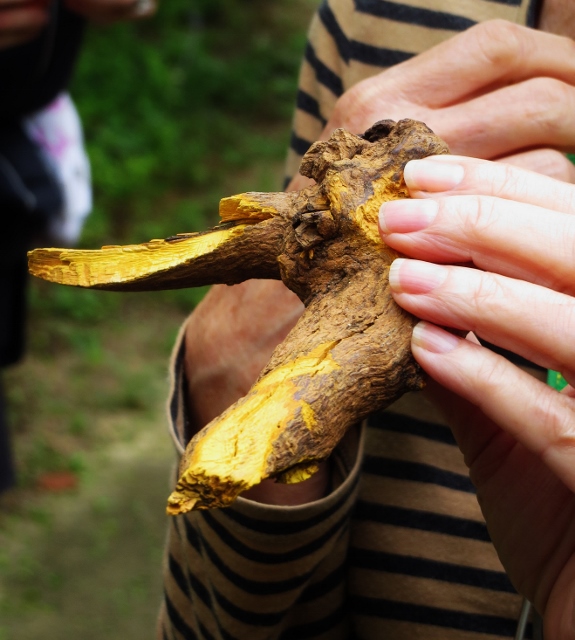
Agarita root
The roots of the agarita (pictured above) were used by the Indians to make yellow dye. They would scrape the roots to make a powder and combine it with another ingredient to make the dye. 

A lot of plants in South Texas have spines or spikes, so watch out if you're hiking here. Our guide told us a story about roadrunners and the spiny hackberry shrub. Apparently, roadrunners have been known to catch lizards and impale them on the spines of the spiny hackberry and come back to eat them later.
Spiny hackberry
The Gum Bumelia tree has reddish-brown bark with deep fissures. Sapsuckers like to probe the bark for insects and songbirds are very fond of the fruit. Children used to chew the gum exuding from the bark.


Gum Bumelia tree's bark
The Pearl Milkweed is a perennial, twining vine which is a nectaring plant for Queen and Monarch butterflies. This milkweed is deer resistant.


Pearl Milkweed
Texas sotol and gray sotol are very useful plants. The sharp tips can be used as needles and the green stems can be separated into long thin fibers and woven into strong cords or mats. The leaves could be woven into mats, trays, and baskets. The pulpy central stems or "hearts" of sotols were baked in an earth oven for 36-48 hours to break down indigestible carbohydrates and poisonous compounds. After baking, the hearts were pounded into patties and dried. These patties, if kept dry, could remain edible for months. The taste was like nutty molasses syrup.


Texas and gray sotol plants

Mat woven from sotol leaves
Notice the sharp edges on the leaves
The Spanish dagger plants are in full bloom and they're very dramatic. Small birds like to nest in the plant because predators (such as snakes) do not come after them there. Our guide told us she uses the edible Spanish dagger flowers in salads.
Spanish dagger plants

Spanish dagger flowers
Next, we learned about the Texas ebony tree, the second-hardest wood of trees in South Texas. The wood is used for fence posts, cabinets, bowls, and fuel. Thick, curved seed pods with high-protein beans are eaten by deer and other small mammals. This evergreen tree is a larval host plant for the Large Orange Sulphur butterfly.
Texas ebony seed pods
Love these starburst-shaped flowers -
can't remember what they are.
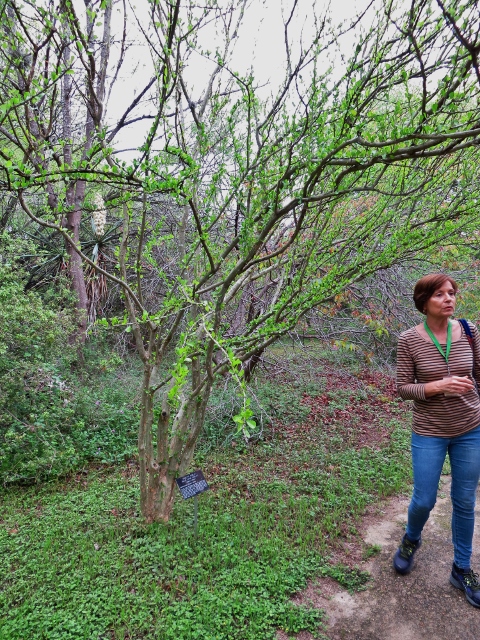
The Guayacan (Soap Bush) below has the most beautiful purple flowers along its branches. This tree has the hardest wood in South Texas which is used for fence posts and tool handles. In Mexican markets, the root bark of this tree is sold for washing wool because it does not fade colors.


Guayacan (Soap Bush)
This next tree is Vasey's Adelia or Blue-Wing Adelia, a host plant for the Mexican Bluewing butterfly.
Vasey's Adelia

Beautiful flower of the Mexican Buckeye

Our guide telling us about Catclaw Acacia

Catclaw Acacia - notice the cat claw-like
thorns on the branch on the right.
Another well-used tree is the honey mesquite. The seed pods could be ground into flour and made into cake-like patties that could be transported long distances and used for sustenance. 


Honey mesquite - the drooping foliage is in the
shape of a wish bone.

Honey mesquite legume pods
Texas prickly pear's new growth
Below is the Texas Sabal Palm, another tree with many uses. The Southern Yellow Bat roosts in the drooping leaves. Edible, dark purple fruits hang in clusters that local wildlife eat. The thick trunks, which are immune to shipworm, are used as wharf pilings. The fronds are used as roof thatching and to make woven items such as chair seats. The fibrous trunk bark is used for weaving.
Texas Sabal Palm

Texas Sabal Palm bark

Deep in the "heart" of Texas
Century plant 
After we finished walking the South Texas Trail, we took a few steps onto the Texas East Piney Woods trail. The lake there is very pretty. We saw northern shoveler ducks, American coot and turtles. Lots of turtles.


Turtles hanging out on a downed log in the lake
As I was driving out of the gardens, this patch of bluebonnets caught my eye. 


I intend to return to the gardens for more nature walks. It was a slow-paced, relaxing time spent in nature. We were on the trail about two hours (over a distance of 1/2 mile or so).

So ends part 1 of Friday. We have some news to share. I'll tell you about it in the next blog.